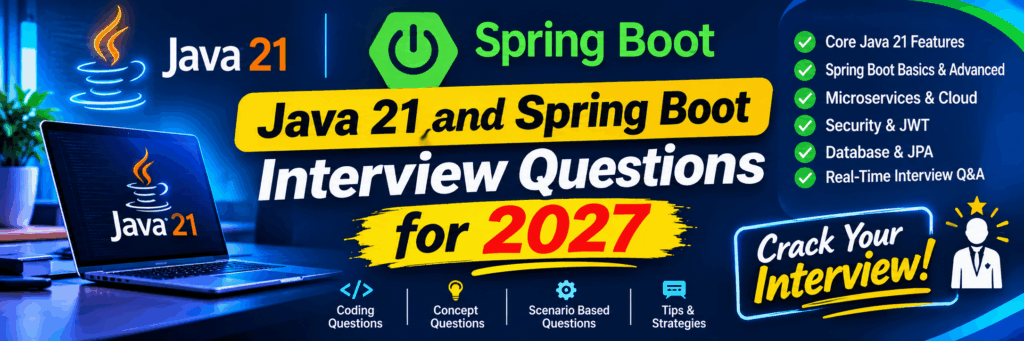
Java 21 and Spring Boot Interview Questions Every Developer Should Prepare in 2027
Preparing for a Java developer interview requires more than memorising Core Java definitions. Companies expect candidates to understand programming fundamentals, write clean code, work with databases and develop applications using modern frameworks like Spring Boot.
With Java 21 offering features such as Virtual Threads, Pattern Matching for Switch and Sequenced Collections, developers should also understand how modern Java applications are built.
Whether you are a fresher, final-year student or experienced developer, these interview questions can help you prepare for technical discussions in 2027.
Important Core Java Interview Questions
Q1. What are the main principles of Object-Oriented Programming in Java?
The four main principles are Encapsulation, Inheritance, Polymorphism and Abstraction. They help developers create reusable, organised and maintainable applications.
Q2. What is the difference between ArrayList and LinkedList?
ArrayList uses a dynamic array and provides efficient indexed access. LinkedList uses linked nodes and can be useful for certain insertion and deletion operations.
Q3. What is the difference between == and equals() in Java?
The == operator compares primitive values or object references, while equals() checks logical equality when appropriately implemented by a class.
.
Java 21 Features Developers Should Know
Java 21 is a Long-Term Support (LTS) release that introduced several important language and platform improvements.
Java 21 Feature | What It Does |
Virtual Threads | Simplifies handling large numbers of concurrent tasks |
Pattern Matching for switch | Makes conditional type checking more readable |
Record Patterns | Simplifies extracting data from record objects |
Sequenced Collections | Provides consistent operations for ordered collections |
Generational ZGC | Improves garbage collection performance |
Q4. What are Virtual Threads in Java 21?
Virtual Threads are lightweight threads managed by the Java runtime. They help applications handle many concurrent tasks without requiring a large number of operating-system threads.
Q5. What is Pattern Matching for switch?
It allows developers to use type patterns and conditions directly within switch expressions and statements, making certain code easier to read.
Spring Boot Interview Questions
Q6. What is Spring Boot?
Spring Boot is a Java framework that simplifies application development by providing auto-configuration, starter dependencies and embedded servers.
Q7. What is Dependency Injection?
Dependency Injection is a design approach in which an object receives the dependencies it needs instead of creating them directly. Spring manages these dependencies through its IoC container.
Q8. What is the difference between @Component, @Service and @Repository?
All three identify Spring-managed components. @Component is a general-purpose annotation, @Service represents business logic, and @Repository identifies data-access components.
REST API and Database Interview Questions
Q9. What is a REST API in Spring Boot?
A REST API allows applications to communicate over HTTP. Spring Boot developers commonly use GET, POST, PUT and DELETE methods to perform operations on application data.
Q10. What is the difference between JPA and Hibernate?
JPA is a Java specification for object-relational mapping, while Hibernate is a popular implementation of that specification.
Q11. How do you connect a Spring Boot application to a database?
Developers commonly configure database properties, add the required dependencies and use Spring Data JPA repositories to perform database operations.
Scenario-Based Interview Questions
Technical interviewers often want to understand how candidates approach real development problems.
– Scenario 1: Your Spring Boot API is responding slowly. How would you identify the issue?
Check application logs, database queries, API response times, thread usage and possible performance bottlenecks.
– Scenario 2: How would you handle exceptions in a REST API?
Use appropriate exception handling, such as @ControllerAdvice and @ExceptionHandler, to return meaningful error responses.
– Scenario 3: How would you protect a Spring Boot application?
Use Spring Security, authentication, authorization, input validation and secure configuration practices.
How Should Freshers Prepare for Java Interviews?
Follow a structured learning approach instead of studying random interview questions.
- Strengthen Core Java, OOP concepts and collections.
- Practise Java coding problems involving strings, arrays and logic.
- Understand Java 21 features and their practical applications.
- Learn Spring Boot, REST APIs and database connectivity.
- Build a mini-project such as an employee management or student management application.
- Practise explaining your project and attend mock interviews.
Frequently Asked Questions
Is Java 21 important for Java developer interviews in 2027?
Yes. Java 21 is an LTS release, and understanding its important features can help developers prepare for modern Java development roles.
Is Spring Boot required for a Java developer job?
Many backend and full-stack Java roles require Spring Boot knowledge, particularly for developing REST APIs and enterprise applications.
Can freshers prepare for Java interviews without work experience?
Yes. Freshers can demonstrate their abilities through coding practice, technical fundamentals and practical projects.
Which topics are important for a Java and Spring Boot interview?
Core Java, OOP, collections, exception handling, Java 21 features, Spring Boot, REST APIs, SQL, JPA and project development are useful preparation areas.
Conclusion: Prepare Beyond Interview Questions
Getting ready for a Java developer interview is about understanding how technologies work together, not simply memorising answers.
Start with Core Java, explore Java 21 features, practise Spring Boot development and build projects that demonstrate your technical knowledge. Regular coding practice and mock interviews can also help improve confidence.
A strong foundation in Java and Spring Boot can help students and freshers prepare for backend development and full-stack Java opportunities.
Keep learning, keep coding and prepare for your next technical interview with confidence!