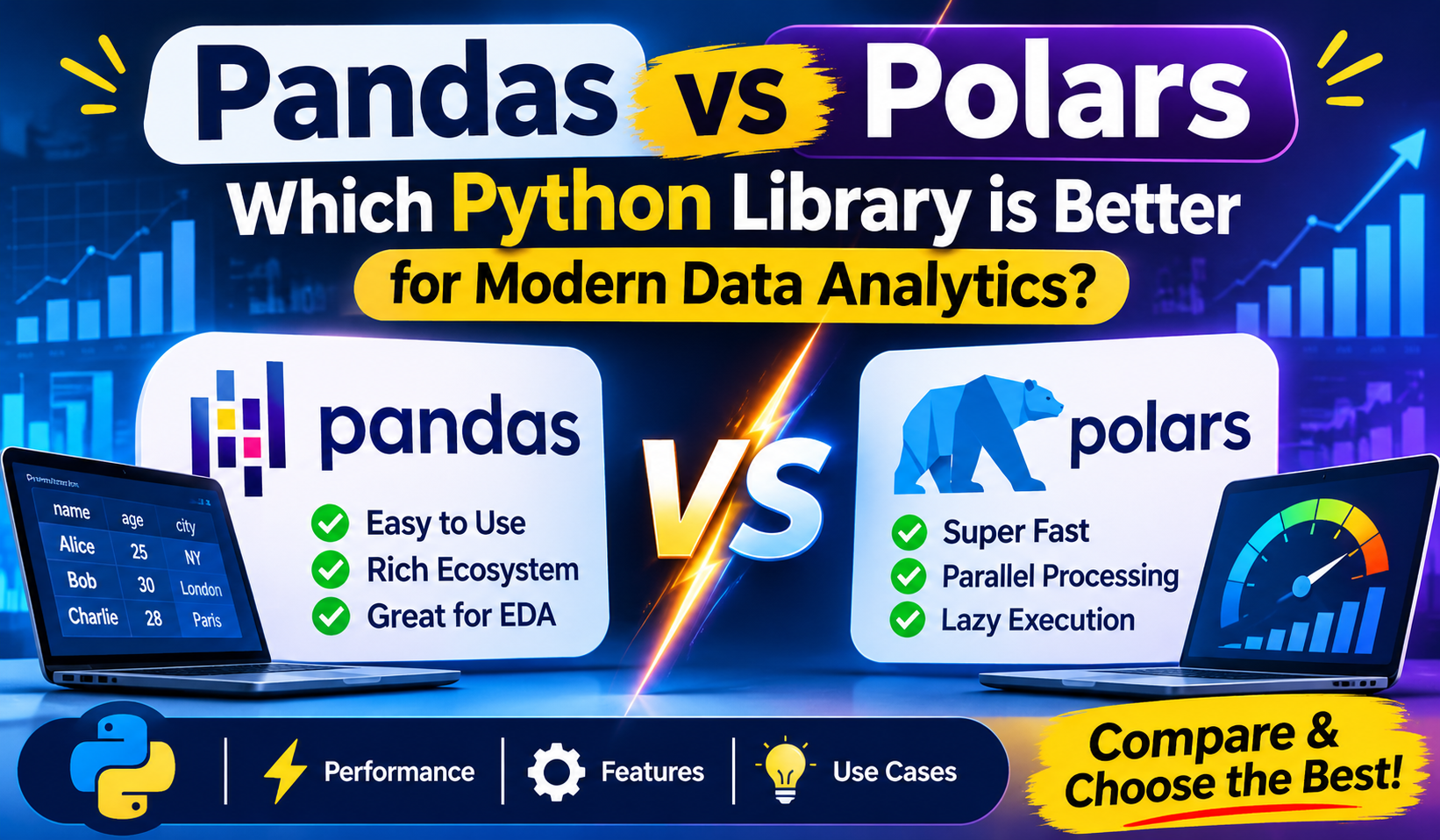
Have you ever wondered how data professionals process thousands or even millions of records using Python? Data analytics requires tools that can clean, transform, organize, and analyze large datasets efficiently. Two popular Python libraries used for these tasks are Pandas and Polars.
Both libraries help developers work with structured data, but they differ in performance, execution methods, and memory management. As businesses handle increasingly large datasets, understanding Pandas vs Polars can help data analysts and developers choose the right tool.
Let’s explore their features, differences, and real-world applications.
Table of Contents
- What Is Pandas?
- What Is Polars?
- Pandas vs Polars: Key Differences
- When Should You Use Pandas or Polars?
- Why Are These Libraries Important for Data Analytics?
- Frequently Asked Questions
What Is Pandas in Python?
Pandas is an open-source Python library widely used for data manipulation and analysis. It provides powerful data structures, including Series and DataFrames, that help users organize and analyze structured information.
For example, a data analyst can use Pandas to clean customer records, calculate sales totals, identify missing values, and generate reports.
Key features of Pandas:
- Easy data cleaning and transformation.
- Supports CSV, Excel, JSON, and SQL data.
- Provides filtering, grouping, and merging operations.
- Works well with NumPy, Matplotlib, and other Python libraries.
What Is Polars in Python?
Polars is a modern DataFrame library designed for fast data processing and analytical workloads. It uses Apache Arrow-based columnar memory and supports parallel execution.
Unlike traditional eager workflows, Polars also provides lazy execution, allowing query operations to be optimized before execution.
Key features of Polars:
- Fast processing of large datasets.
- Supports parallel computation.
- Provides eager and lazy execution.
- Offers query optimization for analytical workloads.
Pandas vs Polars: Key Differences
Features | Pandas | Polars |
Execution | Primarily eager | Eager and lazy |
Performance | Effective for many common workloads | Designed for fast parallel processing |
Memory | Uses its own DataFrame memory model | Uses columnar memory |
Learning curve | Beginner-friendly | Requires learning some new concepts |
Large datasets | Can require significant memory | Often efficient for larger workloads |
Data operations | Cleaning, filtering, grouping | Cleaning, filtering, grouping, optimized queries |
When Should You Use Pandas or Polars?
The right library depends on your project requirements.
Choose Pandas when working with small to medium-sized datasets, performing exploratory data analysis, or using existing Python analytics workflows.
Choose Polars when processing larger datasets, running complex transformations, or building performance-focused data pipelines.
Both libraries are valuable, and learning them together can help developers understand different approaches to Python data analytics.
Why Are Pandas and Polars Important for Data Analytics Careers?
Organizations depend on data to understand customer behaviour, improve business operations, and make informed decisions.
For students, freshers, and IT professionals interested in data careers, learning Python, Pandas, Polars, SQL, statistics, and data visualization can build a strong technical foundation.
Practical projects such as sales analysis, customer data processing, and business reporting help learners understand how data analytics works in real-world situations.
Exploring Full Stack Data Science with Generative AI training in KPHB can also help aspiring professionals develop practical knowledge of Python, Data Science, and modern AI technologies
Frequently Asked Questions
What is the main difference between Pandas and Polars?
Pandas is a widely used Python data analysis library, while Polars focuses on high-performance DataFrame processing with parallel and lazy execution capabilities.
Is Polars faster than Pandas?
Polars can be faster for many large-scale and computationally intensive workloads. However, actual performance depends on the dataset, operations, and hardware.
Should beginners learn Pandas or Polars first?
Pandas is a good starting point because of its extensive learning resources and adoption. Beginners can explore Polars after understanding DataFrame operations.
Can Pandas and Polars be used together?
Yes. Developers can use both libraries in the same Python project and convert data between their DataFrame formats when needed.
Are Pandas and Polars used in Data Science?
Yes. Both libraries support data preparation, transformation, and analysis, which are important stages of Data Science workflows.
Conclusion
Pandas and Polars are useful Python libraries for modern data analytics. Pandas offers an established ecosystem and beginner-friendly workflows, while Polars provides powerful performance-focused features for data processing.
Rather than choosing one library for every situation, developers should understand the strengths of both and select the right tool based on project requirements. Building practical projects with Python and Data Analytics tools can help students and professionals prepare for evolving technology opportunities.