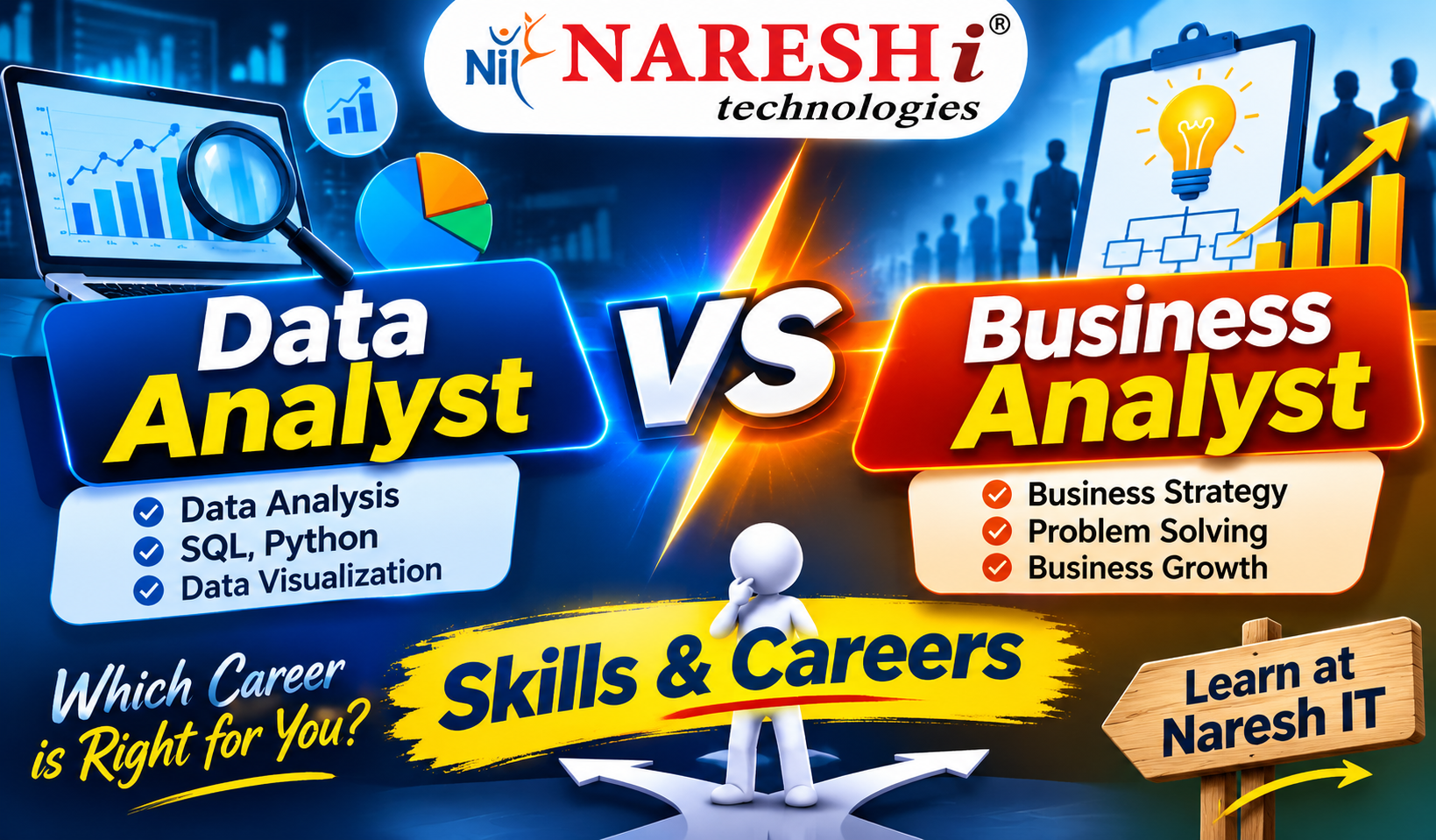
Data Analyst vs Business Analyst: Roles, Skills and Career Opportunities
Every business generates data through sales, customers, marketing campaigns, and daily operations. But collecting data is not enough. Companies need professionals who can understand this information, identify patterns, and support better business decisions. This is where Data Analysts and Business Analysts play important roles.
Although these job titles sound similar, their responsibilities are different. Understanding the difference between a Data Analyst and a Business Analyst can help students and freshers choose a suitable career path.
What Does a Data Analyst Do?
A Data Analyst collects, cleans, studies, and interprets data to identify useful information. Their work helps organisations understand performance, customer behaviour, and business trends.
For example, an online shopping company may notice a drop in monthly sales. A Data Analyst examines sales reports, customer activity, and product performance to identify possible reasons.
Common responsibilities include:
- Collecting and cleaning datasets.
- Analysing information using Excel, SQL, and Python.
- Creating reports and dashboards using Power BI.
- Identifying trends and patterns.
- Presenting data-based findings to teams.
What Does a Business Analyst Do?
A Business Analyst focuses on business needs, processes, and solutions. They communicate with stakeholders, understand challenges, and help teams identify improvements.
For example, if a company wants to improve its customer service process, a Business Analyst studies the existing workflow, gathers requirements, and suggests practical changes.
Common responsibilities include:
- Understanding business requirements.
- Communicating with clients and stakeholders.
- Analysing existing business processes.
- Preparing reports and documentation.
- Coordinating with technical and business teams.
Data Analyst vs Business Analyst: Key Differences
Both roles support business decisions, but they approach problems differently.
Comparison | Data Analyst | Business Analyst |
Main Focus | Data interpretation | Business requirements and processes |
Primary Work | Analysing datasets | Identifying business problems |
Common Tools | Excel, SQL, Python, Power BI | Excel, Jira, SQL, documentation tools |
Key Skills | Data analysis and visualisation | Communication and problem-solving |
Main Output | Reports and dashboards | Requirements and process improvements |
Team Interaction | Data and business teams | Stakeholders and development teams |
Which Skills Should You Learn?
The right skills depend on the career you want to pursue.
Data Analyst Skills | Business Analyst Skills |
Advanced Excel | Business communication |
SQL fundamentals | Requirement gathering |
Python basics | Process analysis |
Power BI dashboards | Documentation |
Data visualisation | Problem-solving |
Some skills, such as analytical thinking, communication, and problem-solving, are valuable in both careers.
Career Opportunities in Data and Business Analytics
Both career paths offer opportunities across industries such as IT, banking, healthcare, retail, e-commerce, and finance.
Career Role | Main Responsibility |
Junior Data Analyst | Preparing and analysing data |
Data Analyst | Finding patterns and presenting insights |
Power BI Analyst | Creating interactive dashboards |
Business Analyst | Understanding business requirements |
Business Process Analyst | Improving business workflows |
Reporting Analyst | Preparing business performance reports |
Career growth depends on practical knowledge, experience, communication, and the ability to solve real business problems. Learning tools alone does not guarantee a job.
How Can Beginners Prepare for These Careers?
Start by understanding basic concepts before moving to advanced tools. Practise working with sample datasets, create simple dashboards, and learn how to explain your findings.
Students exploring Data Analytics and Business Analytics Training in KPHB can look for structured learning that covers relevant concepts, tools, and practical exercises.
At Naresh IT KPHB, learners can explore the Data Analytics & Business Analytics course to understand the fundamentals of analytics and develop skills relevant to these career paths.
Frequently Asked Questions
What is the main difference between a Data Analyst and a Business Analyst?
A Data Analyst works mainly with data to identify trends and insights. A Business Analyst studies business requirements and processes to recommend improvements.
Can freshers start a career in Data Analytics?
Yes. Freshers can begin by learning Excel, SQL, data visualisation, and analytical fundamentals, followed by practical exercises and projects.
Is Python necessary for Data Analysts?
Python is useful for data cleaning, analysis, and automation. However, the tools required can vary depending on the organisation and job role.
Which tools are commonly used in Business Analytics?
Excel, SQL, Power BI, and business documentation tools are commonly used, depending on the responsibilities of the role.
Where can I learn Data Analytics and Business Analytics in KPHB?
Students can explore the Data Analytics & Business Analytics training course at Naresh IT KPHB to learn relevant concepts and tools.
Conclusion
Data Analysts and Business Analysts both contribute to better business decisions, but their responsibilities differ. Data Analysts focus on understanding information, while Business Analysts focus on business needs and process improvements.
If you enjoy working with numbers, reports, and dashboards, Data Analytics may be a suitable direction. If you prefer understanding business challenges and communicating with different teams, Business Analytics may interest you. Choose the path that matches your interests and build your skills through consistent practice.
.