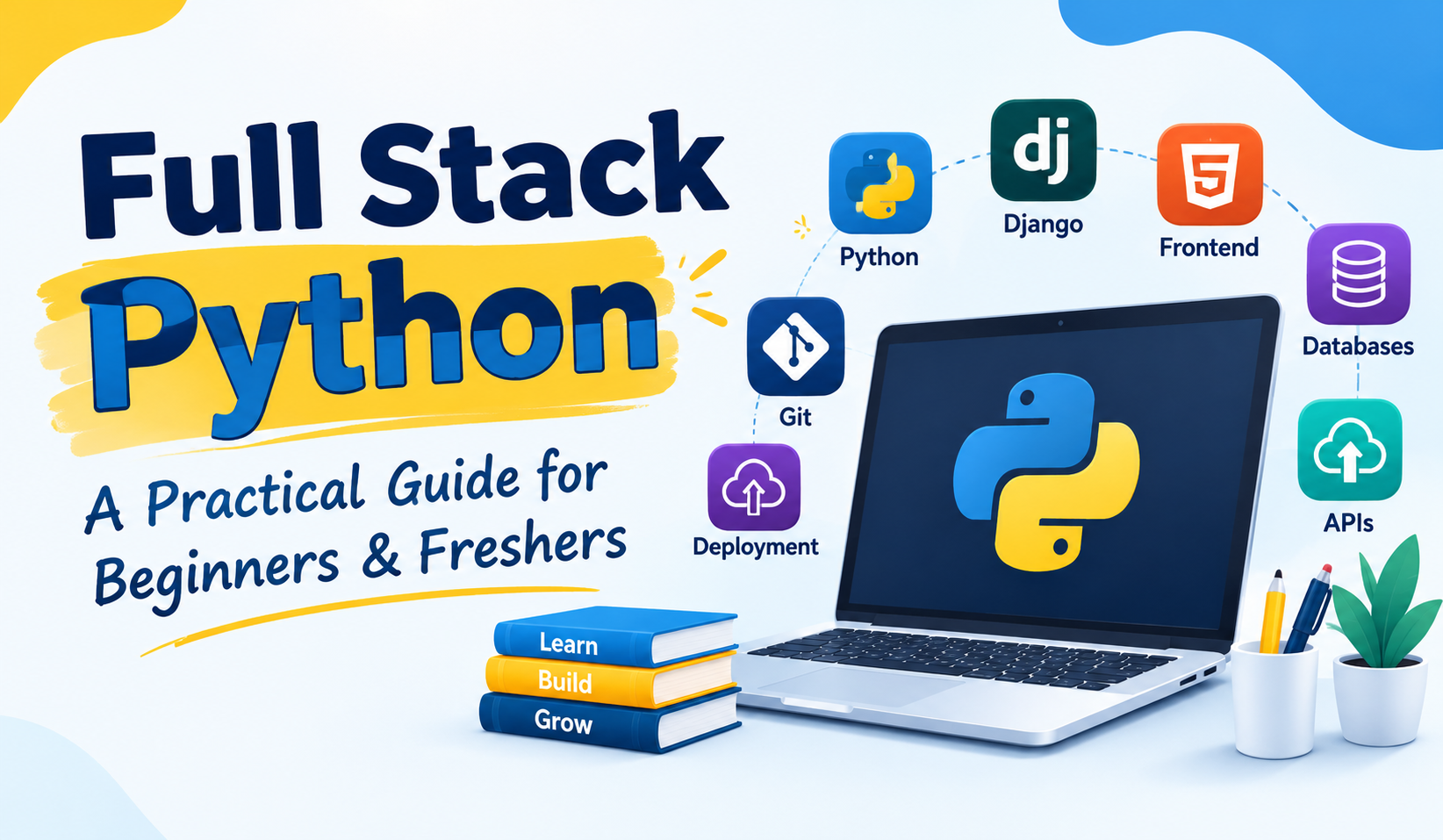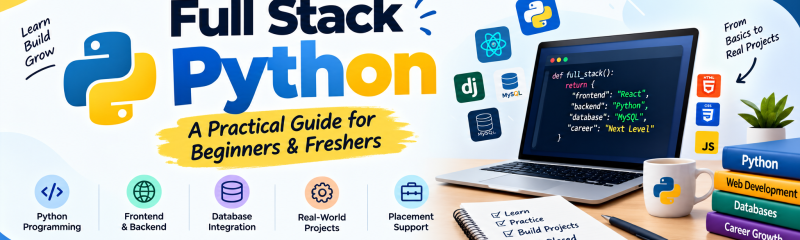
Full Stack Python Development is a popular learning path for students and freshers who want to understand how modern web applications are designed, developed, and deployed. It combines Python programming, backend development, frontend technologies, databases, and application integration to build complete web applications.
For beginners planning to enter the IT industry, learning Python alone may not be enough to understand the complete development process. Full Stack Python helps learners explore both the user-facing part of a website and the server-side logic that powers it.
But what exactly is Full Stack Python, which technologies should you learn, and how can you start building practical development skills?
What Is Full Stack Python Development?
Full Stack Python Development is an approach to web development that uses Python primarily for backend programming, alongside frontend technologies and databases.
A full stack developer understands how different parts of an application work together.
For example, consider an online shopping website. Users can browse products, search for items, add products to their cart, and place orders. The frontend displays the website, the backend processes requests, and the database stores product and customer information.
A Full Stack Python developer learns how these components connect to create a functional application.
Basic development workflow:
Frontend → Backend (Python) → Database → Application Response
Why Should Beginners Learn Full Stack Python?
Python is known for its readable syntax and broad range of applications. It is used in web development, automation, data processing, artificial intelligence, and other technology areas.
Full Stack Python combines Python programming with practical web development skills.
Here are some reasons beginners consider this learning path:
- Beginner-friendly programming: Python syntax is relatively easy to understand when starting programming.
- End-to-end development: Learn how frontend interfaces communicate with backend services.
- Practical project experience: Build websites, registration systems, dashboards, and database-driven applications.
- Flexible technology skills: Understand APIs, databases, application logic, and deployment fundamentals.
- Career preparation: Develop relevant technical skills for entry-level software development opportunities.
Learning a course does not guarantee a job. Practical knowledge, project experience, communication skills, and interview preparation also matter.
What Technologies Are Included in Full Stack Python?
A structured Full Stack Python learning path typically covers the following technologies.
Technology | Purpose |
|---|---|
Python | Programming fundamentals, functions, data structures, and OOP |
HTML | Creating webpage structure |
CSS | Styling and responsive layouts |
JavaScript | Adding interactive website features |
Django or Flask | Developing Python-based backend applications |
SQL | Managing and querying database information |
REST APIs | Connecting applications and exchanging data |
Git and GitHub | Version control and code collaboration |
React | Building interactive frontend interfaces |
Deployment | Making applications available online |
The exact syllabus varies between training programs. Beginners should first understand Python fundamentals before progressing to frameworks and advanced development concepts.
How Does Full Stack Python Work in a Real Project?
Consider a student registration application.
A student enters their name, email address, and selected course into a registration form. The frontend collects the information and sends it to the backend.
Python, using Django or Flask, processes the request and validates the submitted information. The database stores the registration details, and the application displays a confirmation message.
While building this project, learners can practise:
- Creating webpages with HTML and CSS.
- Adding form validation and interactive features.
- Writing backend logic using Python.
- Connecting the application to a database.
- Testing functionality and fixing errors.
- Using Git to manage code changes.
- Deploying the completed project.
Building projects like these helps beginners understand how individual technologies work together in practical software development.
Full Stack Python vs Python Programming
Python programming focuses on learning the language, solving problems, and writing programs.
Full Stack Python Development extends those fundamentals by introducing frontend technologies, backend frameworks, databases, APIs, and complete application development.
Students interested in web development can benefit from understanding both Python programming and the technologies required to build a functional website.
Common Mistakes Beginners Should Avoid
1. Skipping Python fundamentals: Learn variables, functions, data structures, and object-oriented programming before advanced frameworks.
2. Watching tutorials without practising: Write code independently and solve small programming problems.
3. Ignoring databases: Learn how applications store, retrieve, and update information.
4. Learning multiple frameworks simultaneously: Begin with Django or Flask and develop a strong understanding of one framework.
5. Not building projects: Start with small applications and gradually increase their complexity.
6. Ignoring Git and debugging: These skills help you manage code and identify problems efficiently.
.
Frequently Asked Questions About Full Stack Python
1. What is Full Stack Python Development?
Full Stack Python Development combines Python backend programming with frontend technologies, databases, APIs, and application development.
2. Is Full Stack Python suitable for freshers?
Yes. Freshers can begin with Python fundamentals and gradually learn web development, databases, backend frameworks, and practical projects.
3. Can I learn Full Stack Python without prior coding experience?
Yes. You can start without professional coding experience. Regular practice and a step-by-step learning approach are important.
4. What is the difference between Django and Flask?
Django is a comprehensive Python web framework with many built-in features. Flask is a lightweight framework that provides flexibility when choosing application components.
5. What projects can beginners build?
Beginners can develop student management systems, task management applications, registration portals, product catalogues, and simple e-commerce websites.
6. What jobs can I prepare for after learning Full Stack Python?
Depending on your skills and project experience, you can prepare for roles such as Junior Python Developer, Junior Web Developer, Backend Developer, or Full Stack Developer.
7. Where can I learn Full Stack Python in Hyderabad?
Students can compare Full Stack Python training in KPHB, Hyderabad, by reviewing the syllabus, practical projects, trainer support, and placement assistance offered by the institute.
Final Thoughts
Full Stack Python Development provides a structured way to learn modern web application development. Instead of focusing only on programming syntax, learners can understand how websites operate, how databases work, and how different technologies connect.
Follow this learning sequence:
Python Fundamentals → HTML and CSS → JavaScript → Django or Flask → SQL → REST APIs → Practical Projects → Git and Deployment
For students and freshers looking for guided learning, NareshIT KPHB, Hyderabad, is one option to explore for Full Stack Python training. Review the course curriculum and practical learning opportunities before choosing a program that suits your career goals.