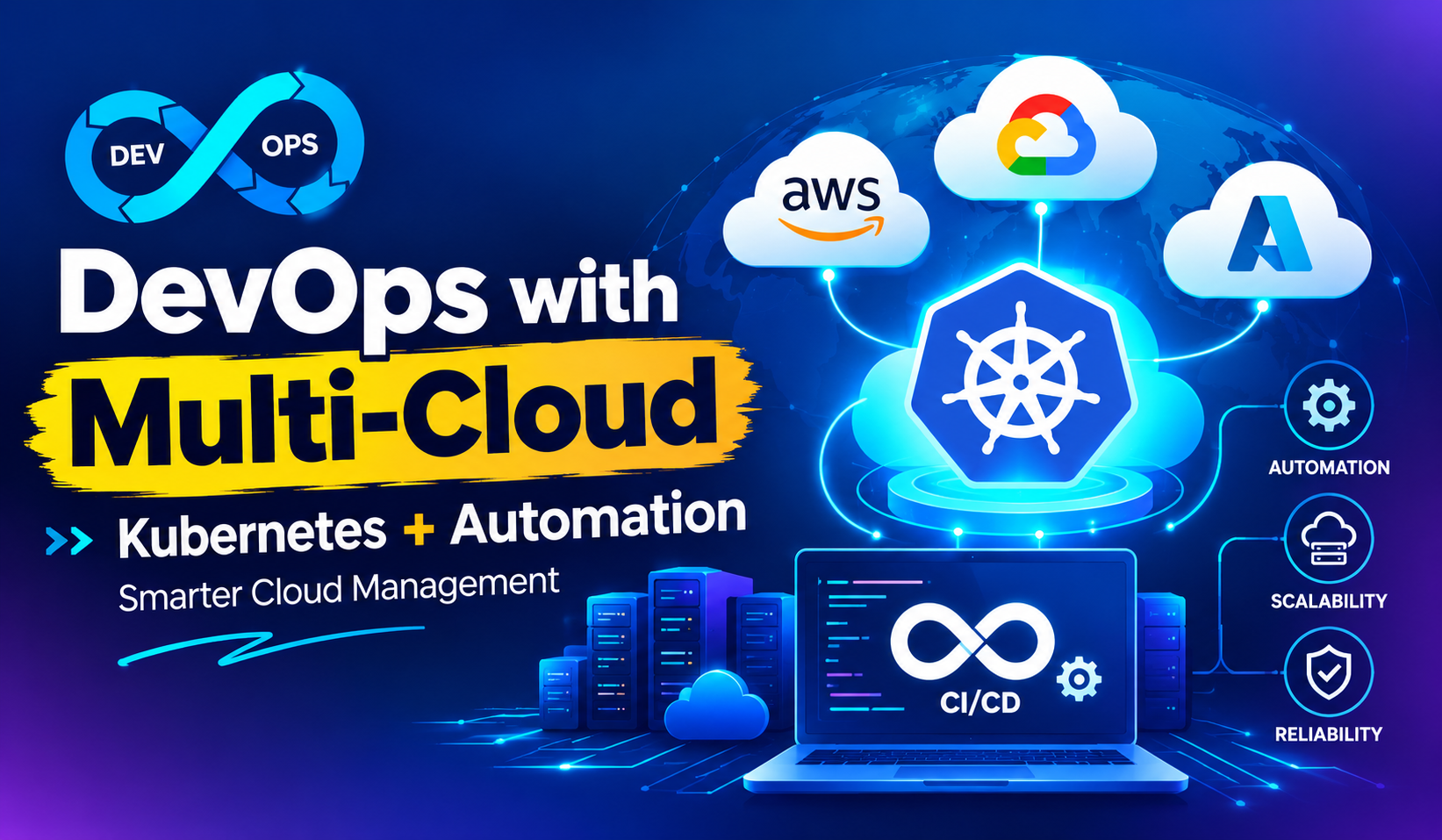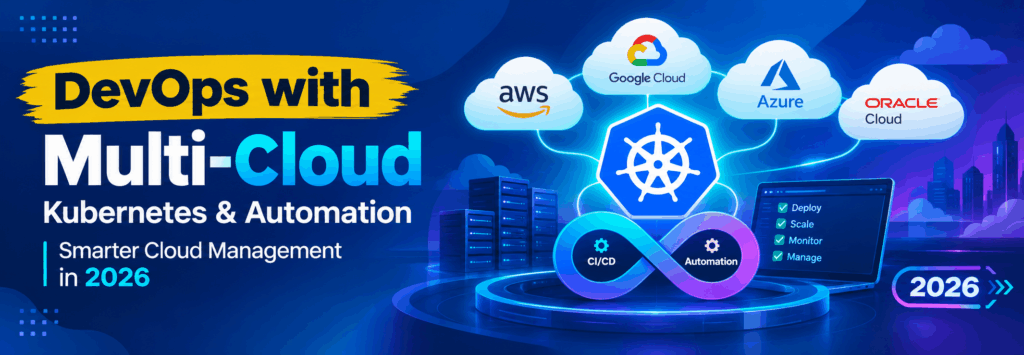
DevOps with Multi-Cloud: How Kubernetes and Automation Are Changing Cloud Management in 2026
Modern applications need reliable infrastructure, faster deployments, and the ability to handle changing workloads. Many organizations use cloud platforms such as AWS, Microsoft Azure, and Google Cloud to run their applications and services.
Managing these environments requires more than knowing individual cloud services. DevOps teams also need automation, monitoring, security, and consistent deployment processes. This is where DevOps with Multi-Cloud becomes important.
Recent developments in Kubernetes and cloud-native technologies show how the industry is working toward easier management of applications across multiple clusters and environments. For students and freshers, learning these concepts provides a practical foundation for understanding modern cloud operations.
.
What Is DevOps with Multi-Cloud?
DevOps combines development and IT operations practices to improve software delivery through collaboration, automation, testing, deployment, and monitoring.
Multi-cloud means using services from two or more cloud providers. For example, an organization might run one application on AWS and use Azure or Google Cloud for other workloads.
When DevOps practices are applied to a multi-cloud environment, teams can automate infrastructure setup, maintain deployment consistency, monitor application health, and manage resources across different platforms.
Latest DevOps and Multi-Cloud Developments in 2026
Several developments highlight the growing importance of cloud-native automation and multi-cluster management.
1. Kubernetes 1.37 Focuses on Cloud-Native Operations
Kubernetes 1.37 was reported as released in September 2026. Kubernetes helps teams deploy, scale, and manage containerized applications. Its continuing development is important for organizations operating applications across multiple clusters.
For DevOps engineers, understanding Kubernetes workloads, networking, configuration, security, and cluster maintenance remains valuable.
2. Karmada Reaches CNCF Graduation
In September 2026, the multi-cluster project Karmada reached Cloud Native Computing Foundation (CNCF) graduation. Karmada is designed to help manage applications across multiple Kubernetes clusters, including clusters distributed across different environments.
This development highlights the importance of coordinating workloads across clusters instead of managing every cluster entirely separately.
Important: Multi-cluster Kubernetes management and multi-cloud management are related, but they are not identical. A company can run multiple clusters within one cloud provider or distribute them across multiple providers.
3. Automation and Infrastructure as Code Remain Important
Infrastructure as Code (IaC) allows teams to define infrastructure using configuration files instead of relying entirely on manual setup. Tools such as Terraform help teams manage infrastructure changes in a repeatable way.
Combined with CI/CD pipelines, IaC can reduce configuration differences and make infrastructure changes easier to review and track.
Further reading: Kubernetes news and developments.
Tools Used in DevOps with Multi-Cloud
Tool or technology | Main purpose | Example use |
Git | Version control | Track application and configuration changes |
Jenkins or GitHub Actions | CI/CD automation | Build, test, and deploy code |
Docker | Containerization | Package applications and dependencies |
Kubernetes | Container orchestration | Deploy and scale containerized applications |
Terraform | Infrastructure as Code | Provision cloud infrastructure |
Prometheus and Grafana | Monitoring and visualization | Track application and infrastructure metrics |
Ansible | Configuration management and automation | Configure servers and automate operational tasks |
Tool selection depends on the organization’s architecture, security requirements, budget, and existing technology stack.
How Does a Multi-Cloud DevOps Workflow Work?
Step 1: Store Code in Version Control
Developers push application code and configuration changes to a shared Git repository.
Step 2: Build and Test Automatically
A CI pipeline builds the application and runs automated tests to identify issues before deployment.
Step 3: Provision Infrastructure
Infrastructure as Code can create or update the required resources in supported cloud environments after appropriate review and approval.
Step 4: Deploy Applications
A deployment pipeline releases the application to the selected environment. Kubernetes can manage containerized workloads where it is part of the architecture.
Step 5: Monitor and Improve
Monitoring tools help teams identify errors, performance issues, resource usage, and service interruptions. Teams can use these insights to improve reliability and manage costs.
Common Mistakes to Avoid in Multi-Cloud DevOps
1. Assuming Every Cloud Provider Works the Same Way
Cloud providers have different services, permissions, networking models, and pricing structures. Teams should understand these differences before designing a common deployment process.
2. Ignoring Security and Access Management
Using multiple cloud environments increases the number of permissions and configurations that teams must manage. Apply least-privilege access, secure secret storage, and regular access reviews.
3. Automating Without Testing
An infrastructure change that works in one environment may fail in another. Test configuration changes and review plans before applying them to production.
4. Overlooking Cloud Costs
Running duplicate resources, unused clusters, or oversized workloads can increase spending. Monitor usage and establish budgets and cost alerts.
5. Adopting Too Many Tools at Once
A complicated toolchain can make troubleshooting difficult. Begin with the tools required for version control, automation, infrastructure management, and monitoring, then expand as needed.
Why Should Students and Freshers Learn Multi-Cloud DevOps?
Learning DevOps with multi-cloud concepts helps beginners understand how applications move from development to production. It also introduces them to automation, containers, infrastructure management, monitoring, and cloud security.
A useful learning path is to start with Linux, networking, and Git; then practise Docker, CI/CD, Terraform, and Kubernetes. After learning the fundamentals, explore the core services and access-management concepts of cloud platforms.
Hands-on projects are especially useful. For example, a learner can build a simple application, package it in a container, automate its tests, and deploy it to a Kubernetes test environment.
Frequently Asked Questions
What is DevOps with Multi-Cloud?
It is the use of DevOps practices and automation to build, deploy, monitor, and manage applications that use services from multiple cloud providers.
Is Kubernetes required for multi-cloud DevOps workflows?
No. Kubernetes is useful for container orchestration across clusters, but multi-cloud DevOps can also involve virtual machines, managed services, serverless applications, and other deployment models.
What is the role of Terraform in multi-cloud environments?
Terraform allows teams to define and manage supported infrastructure resources through configuration files. Its provider model enables interaction with different platforms, subject to each provider’s capabilities.
What is the difference between multi-cloud and hybrid cloud?
Multi-cloud involves using more than one cloud provider. Hybrid cloud generally combines private infrastructure with public cloud services, although specific definitions can vary between organizations.
Which skills should a fresher learn first?
Start with Linux, networking basics, Git, scripting, Docker, CI/CD, and cloud fundamentals. Then learn Infrastructure as Code, Kubernetes, monitoring, and security practices through small projects.
Conclusion
DevOps with multi-cloud is about making application delivery and infrastructure management more consistent across different environments. Kubernetes developments, multi-cluster management, and Infrastructure as Code demonstrate why automation and operational skills remain important in modern cloud-native systems.
Students and freshers can begin with the fundamentals, practise one tool at a time, and gradually build projects that demonstrate their understanding of deployment, monitoring, and cloud infrastructure.