RAG vs Fine-Tuning: Which Is Better for Building Smarter AI Applications?
Artificial Intelligence is transforming modern application development. From intelligent chatbots to business automation, AI helps developers build applications that understand user questions and generate meaningful responses. Generative AI and Large Language Models (LLMs) are playing an important role in this transformation.
Two popular techniques used in AI development are Retrieval-Augmented Generation (RAG) and Fine-Tuning. Both improve AI applications but work differently. Understanding RAG vs Fine-Tuning helps developers choose the right approach for building smarter AI solutions.
Table of Contents
- What Is Retrieval-Augmented Generation (RAG)?
- What Is Fine-Tuning and How Does It Work?
- Key Differences Between RAG and Fine-Tuning
- Real-World Applications
- Which Approach Should Developers Choose?
- Skills Required for AI Development
- Frequently Asked Questions
What Is Retrieval-Augmented Generation (RAG)?
Retrieval-Augmented Generation (RAG) is an AI technique that connects Large Language Models with external information sources. It retrieves relevant information from documents, databases, and knowledge bases before generating responses.
For example, a company can develop an AI chatbot that answers customer questions using product details, company policies, and other business documents.
Important features of RAG include:
- Information Retrieval: Finds relevant information from external sources.
- Vector Databases: Supports searching information using embeddings.
- Updated Knowledge: Allows applications to access updated information without retraining the model.
RAG is useful for AI chatbots, enterprise search, and document-based question-answering systems.
What Is Fine-Tuning and How Does It Work?
Fine-Tuning is the process of training an existing pre-trained AI model using additional task-specific datasets. It helps models adapt to particular requirements and improve performance on specialized tasks.
For example, a business can fine-tune an AI model to generate customer support responses in a consistent format.
Fine-Tuning is useful for customized content generation, text classification, and applications that require specific response styles.
Key Differences Between RAG and Fine-Tuning
Although both techniques improve AI applications, their working methods are different.
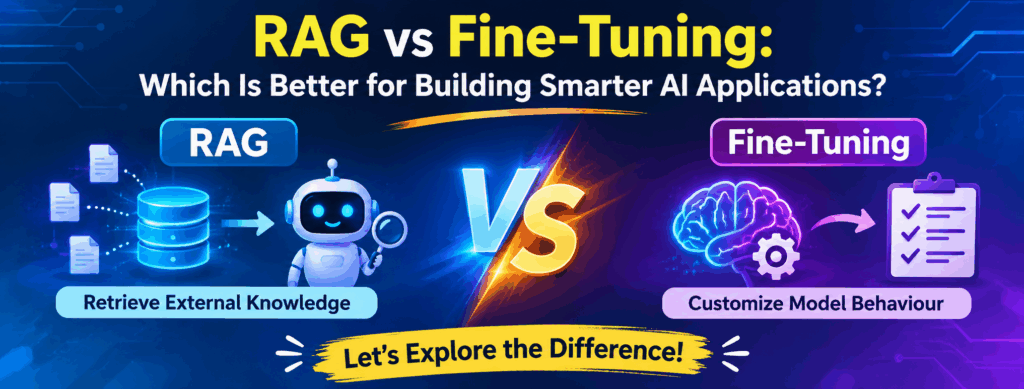
Feature | RAG | Fine-Tuning |
Purpose | Retrieves external information | Customizes model behaviour |
Process | Information retrieval | Additional model training |
Data Source | Documents and databases | Training datasets |
Model Weights | Remain unchanged | Are updated |
Best Use | Updated knowledge | Specialized tasks |
Applications | AI chatbots and search | Customized AI solutions |
Real-World Applications of RAG and Fine-Tuning
Both techniques support different business requirements. RAG helps customer support systems retrieve updated product information and enables employees to search internal documents.
Fine-Tuning supports customized content generation, programming assistants, text classification, and specialized business applications.
Developers can also combine both techniques to build AI applications that provide updated information and customized responses.
Which Approach Should Developers Choose?
Choosing between RAG and Fine-Tuning depends on project requirements.
RAG is suitable when applications need frequently updated information from external sources. Fine-Tuning is useful when developers want to customize model behaviour for specific tasks.
Combining both approaches can be beneficial when an application requires updated knowledge and consistent responses.
Skills Required for AI Development
Developers interested in Generative AI should understand Python programming, Machine Learning, Large Language Models, Prompt Engineering, RAG architecture, Vector Databases, Fine-Tuning, and API integration.
Practical projects such as AI chatbots and document question-answering applications help learners understand these technologies.
Frequently Asked Questions
What is the main difference between RAG and Fine-Tuning?
RAG retrieves external information to generate answers, while Fine-Tuning trains an existing model for specific tasks.
Which is better, RAG or Fine-Tuning?
RAG is useful for updated information, while Fine-Tuning is suitable for specialized tasks. The choice depends on application requirements.
Can RAG and Fine-Tuning work together?
Yes. Both techniques can be combined to provide updated knowledge and customized AI responses.
Which programming language is used for RAG development?
Python is commonly used for RAG development along with AI frameworks and vector databases.
Can beginners learn Generative AI development?
Yes. Beginners can start with Python, Machine Learning fundamentals, and LLM concepts before learning RAG and Fine-Tuning.
Conclusion
RAG and Fine-Tuning are important techniques in modern Artificial Intelligence development. While RAG helps AI models retrieve external information, Fine-Tuning improves their performance on specialized tasks.
Understanding both approaches can help developers build smarter AI applications for different business requirements. Learning Python, Generative AI, and Large Language Models can help students, freshers, and professionals develop practical AI skills.
Discussion Question: Which approach would you choose for your next AI application — RAG, Fine-Tuning, or both?