Students planning a career in technology often come across two popular terms: Data Science and Artificial Intelligence.
Both involve data. Both can use Python and Machine Learning. Both are connected to modern technology careers.
But they are not the same.
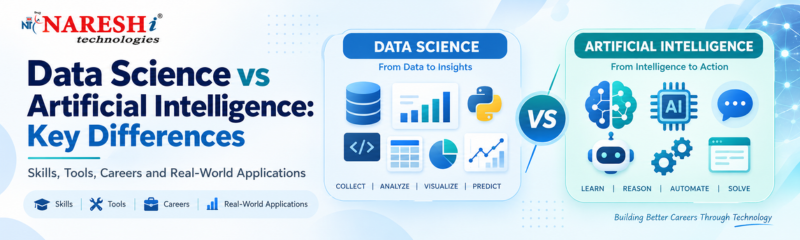
In simple terms, Data Science focuses on understanding data and finding useful insights, while Artificial Intelligence focuses on building systems that can perform intelligent tasks.
If you are confused about which path to choose, this comparison will help you understand the difference clearly.
Data Science vs Artificial Intelligence: Quick Comparison
| Area | Data Science | Artificial Intelligence |
|---|---|---|
| Main Goal | Understand and analyze data | Build intelligent systems |
| Main Focus | Insights, patterns, predictions | Automation, reasoning, intelligent behavior |
| Python | Important | Very Important |
| SQL | Very Important | Useful |
| Statistics | Very Important | Important |
| Machine Learning | Commonly used | Core area |
| Deep Learning | Sometimes required | Often important |
| Generative AI | Advanced area | Major AI area |
| Typical Output | Reports, predictions, models | AI apps, chatbots, agents, intelligent systems |
| Best For | People who enjoy data and analysis | People who enjoy AI systems and automation |
What Is Artificial Intelligence?
Artificial Intelligence is about building software that can perform tasks that normally require some level of human intelligence.
These tasks may include:
- Understanding language
- Recognizing images
- Generating text
- Making recommendations
- Answering questions
- Planning actions
- Automating decisions
AI is used in chatbots, recommendation systems, fraud detection, voice assistants, image recognition, Generative AI tools and AI agents.
The main difference is that AI usually focuses more on what the system can do, while Data Science focuses more on what the data can tell us.
Where Does Machine Learning Fit?
Machine Learning is one of the strongest connections between Data Science and Artificial Intelligence.
A Data Scientist may use Machine Learning to predict customer churn.
An AI Engineer may use Machine Learning inside an application that makes recommendations or decisions.
So Machine Learning belongs to both worlds.
You can think of it like this:
- Data Science + Machine Learning = Prediction and analysis
- Artificial Intelligence + Machine Learning = Intelligent applications
Skills Required for Data Science and AI
| Skill | Data Science | Artificial Intelligence |
|---|---|---|
| Python | High | High |
| SQL | High | Medium |
| Statistics | High | Medium to High |
| Data Cleaning | High | Medium |
| Data Visualization | High | Medium |
| Machine Learning | High | High |
| Deep Learning | Medium | High |
| NLP | Specialized | High for language AI |
| Generative AI | Growing skill | Major skill |
| APIs | Useful | Important |
| Cloud | Useful | Important |
| Model Deployment | Useful | Important |
| AI Agents | Limited | Growing rapidly |
Which Is Easier for Beginners?
For many beginners, Data Science may feel easier to enter step by step because the learning path often starts with:
- Python → SQL → Statistics → Data Analysis → Machine Learning
- Artificial Intelligence can become more technical when you move into:
- Deep Learning → NLP → LLMs → Generative AI → RAG → AI Agents
- That does not mean AI is only for advanced learners.
- It simply means that a strong foundation helps.
- If you are completely new, start with the basics before jumping directly into advanced AI tools.
Should You Learn Data Science Before AI?
You do not need to complete the entire Data Science field before learning AI.
However, Data Science gives you useful foundations.
You learn:
- How data is collected
- How data is cleaned
- How models are evaluated
- How statistics supports decisions
- How Machine Learning works
These concepts are useful when working with AI systems.
A good beginner path is:
Python → SQL → Statistics → Data Analysis → Machine Learning → AI Specialization
From there, you can choose areas such as Generative AI, NLP, Deep Learning or AI Agents.
Data Scientist vs AI Engineer
| Data Scientist | AI Engineer |
|---|---|
| Works deeply with datasets | Builds AI-powered applications |
| Performs analysis | Integrates AI models |
| Uses statistics | Uses software engineering |
| Builds predictive models | Builds AI workflows |
| Performs EDA | Works with APIs |
| Evaluates models | Deploys AI systems |
| Uses ML | Uses ML, LLMs and AI frameworks |
Which Career Fits You?
Ask yourself what you enjoy.
If you like:
- Working with datasets
- Finding patterns
- Statistics
- Business insights
- Predictive analysis
Then Data Science may suit you.
If you like:
- Building AI applications
- Chatbots
- Generative AI
- Deep Learning
- AI agents
- Automation
Then Artificial Intelligence may interest you more.
If you enjoy Machine Learning and Python, both paths can work.
Frequently Asked Questions
1. Is Data Science the same as Artificial Intelligence?
No. Data Science focuses mainly on data analysis, insights and predictive models. Artificial Intelligence focuses on building systems that can perform intelligent tasks.
2. Is Machine Learning part of Data Science or AI?
Machine Learning is used in both Data Science and Artificial Intelligence.
3. Which is better for beginners?
Data Science can provide a structured starting point because it teaches Python, data analysis, statistics and Machine Learning fundamentals.
4. Do I need Python for both?
Yes. Python is widely used in Data Science, Machine Learning, Deep Learning and AI development.
5. Is mathematics required for AI?
Basic mathematics and statistics are useful. Advanced topics may require more mathematical understanding, especially in Machine Learning and Deep Learning.
6. Can a Data Scientist become an AI Engineer?
Yes. Data Scientists can move toward AI Engineering by learning software development, deployment, APIs, Deep Learning, LLMs and AI application development.
7. Can non-IT students learn Data Science and AI?
Yes. Non-IT students can enter both fields, but they should build programming and technical foundations step by step.
8. Is Generative AI part of Artificial Intelligence?
Yes. Generative AI is a branch of Artificial Intelligence that creates outputs such as text, images, code and audio.
9. Which career needs more coding?
Both require coding, but AI Engineering usually involves more software integration and application development.
10. Can I learn Data Science first and move to AI later?
Yes. This is a practical learning path because Data Science builds strong foundations in Python, statistics, data handling and Machine Learning.
Final Thoughts
The difference between Data Science vs Artificial Intelligence becomes easier to understand when you look at the goal of each field.
Data Science helps you understand data. Artificial Intelligence helps you build systems that can act intelligently. Machine Learning connects both.
If you are a beginner, do not worry about choosing the perfect path immediately. Start with Python, SQL, statistics and data analysis. Learn Machine Learning. Build projects.
Then decide whether you enjoy working more with data and predictions or with AI applications and intelligent systems.