A beginner entering the data and AI field often hears terms such as Data Science, Machine Learning, Artificial Intelligence, Deep Learning and Generative AI.
Among these, one of the most common questions is:
“What is the difference between Data Science and Machine Learning?”
The simple answer is:
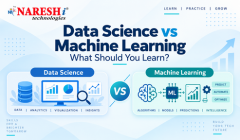
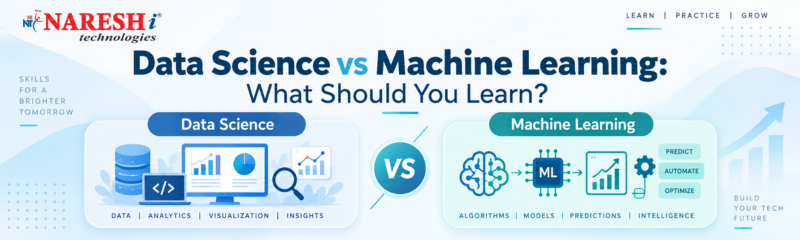
Data Science is a broader field that focuses on collecting, analysing and understanding data. Machine Learning is a technique that allows computers to learn patterns from data and make predictions or decisions.
Machine Learning can be part of Data Science, but Data Science includes much more than Machine Learning.
Understanding this difference can help students choose the right learning path instead of jumping directly into algorithms without learning the fundamentals.
Data Science vs Machine Learning: Quick Comparison
| Area | Data Science | Machine Learning |
|---|---|---|
| Main Goal | Understand and solve problems using data | Build systems that learn from data |
| Scope | Broad | More specialized |
| Data Cleaning | Very important | Important |
| SQL | Very important | Useful |
| Python | Very important | Very important |
| Statistics | Important | Very important |
| Visualization | Important | Limited |
| Machine Learning | One part of the field | Main focus |
| Business Understanding | Very important | Important |
| Model Building | Common | Core activity |
| Deployment | Sometimes required | Often useful |
The exact responsibilities depend on the company and project.
What Is Machine Learning?
Machine Learning focuses on teaching computers to identify patterns from data.
Instead of writing a fixed rule for every situation, we train a model using previous examples.
Suppose a bank wants to identify whether a loan applicant may default.
The model can learn from past customer information such as:
- Income
- Loan amount
- Repayment history
- Credit behaviour
- Employment details
The Machine Learning model studies patterns in historical data and produces a prediction for new applicants.
This is different from simply analysing what happened in the past.
Machine Learning is often used when we want the system to predict, classify or recommend something automatically.
A Simple Real-World Example
magine an online streaming platform.
Data Science Work :
A Data Scientist may analyse:
- Which movies are watched most?
- At what time are users most active?
- Which age group watches a particular category?
- Why are users cancelling subscriptions?
Machine Learning Work :
A Machine Learning model may predict:
- Which movie a user may like next
- Which customer may cancel
- Which content should appear on the homepage
- Which users belong to similar preference groups
So:
- Data Science helps understand the complete data problem.
- Machine Learning helps build predictive systems using patterns in that data.
Is Machine Learning Part of Data Science?
Yes, in many projects.
Machine Learning is commonly used inside a Data Science workflow.
A typical project may look like this:
Business Problem → Data Collection → Data Cleaning → Data Analysis → Feature Preparation → Machine Learning → Evaluation → Results
- Machine Learning appears after several earlier steps.
- This is why beginners should not start by memorising algorithms alone.
- If the dataset is poor or the problem is not clearly understood, even a powerful model may give poor results.
Data Science vs Machine Learning Skills
| Skill | Data Science | Machine Learning |
|---|---|---|
| Python | High | High |
| SQL | High | Medium |
| Pandas | High | High |
| NumPy | High | High |
| Statistics | High | High |
| Visualization | High | Medium |
| Data Cleaning | High | High |
| Feature Engineering | High | High |
| ML Algorithms | Medium to High | Very High |
| Model Evaluation | High | Very High |
| Deep Learning | Optional | Advanced ML path |
| Deployment | Useful | Important for production roles |
This is a general learning comparison, not a fixed job requirement.
What Machine Learning Algorithms Should Beginners Learn?
You do not need to learn dozens of algorithms immediately.
Start with a few important ones.
Linear Regression
- Used when predicting numerical values such as prices or sales.
Logistic Regression
- Often used for classification problems.
Decision Tree
- Creates decision-based rules from data.
Random Forest
- Combines multiple decision trees to improve predictions.
K-Nearest Neighbours
- Uses similar examples to make predictions.
K-Means Clustering
- Groups similar data points without predefined labels.
Data Scientist vs Machine Learning Engineer
| Data Scientist | Machine Learning Engineer |
|---|---|
| Analyses data | Builds production ML systems |
| Performs EDA | Optimizes ML pipelines |
| Uses statistics | Focuses strongly on ML engineering |
| Builds models | Deploys and scales models |
| Communicates insights | Integrates models with applications |
| Uses SQL frequently | Uses software engineering heavily |
| Business understanding matters | System performance matters |
Which Career Fits You?
Data Science may suit you if you enjoy:
- Working with datasets
- SQL
- Finding business insights
- Statistics
- Data visualization
- Solving business problems
- Building predictive models
Machine Learning may suit you if you enjoy:
- Python programming
- Algorithms
- Model training
- Experimentation
- Improving predictions
- Deep Learning
- Deploying intelligent systems
If you enjoy both, that is perfectly normal.
The two areas overlap heavily.
What Projects Can Beginners Build?
For Data Science, beginners can start with:
- Sales analysis
- Customer behaviour analysis
- E-commerce data exploration
- Marketing campaign analysis
- HR analytics
For Machine Learning, try:
- House price prediction
- Customer churn prediction
- Loan approval prediction
- Spam detection
- Customer segmentation
- Recommendation systems
A strong project should explain the problem and your thinking, not just show code.
Frequently Asked Questions
1. Is Machine Learning the same as Data Science?
No. Machine Learning is one technique used within Data Science and AI. Data Science is a broader field that also includes data cleaning, analysis, statistics and visualization.
2. Should I learn Data Science before Machine Learning?
For beginners, learning Data Science fundamentals first can make Machine Learning easier because you understand how to work with data before building models.
3. Does Data Science require Machine Learning?
Not every Data Science task requires Machine Learning. Some projects focus mainly on analysis, reporting or statistical insights.
4. Which requires more coding?
Both require programming. Machine Learning-focused roles can require deeper coding, especially when models need to be deployed into real applications.
5. Is Python required for Machine Learning?
Python is widely used because it has many libraries for data analysis and Machine Learning.
6. Is SQL required for Machine Learning?
SQL is not a Machine Learning algorithm, but it is useful because real-world data is often stored in databases.
7. Can non-IT students learn Machine Learning?
Yes. Non-IT students can learn Machine Learning, but they should first build Python, mathematics, statistics and data-handling skills.
8. Is Machine Learning harder than Data Science?
Machine Learning can become more mathematically and technically challenging, while Data Science covers a broader range of skills. Difficulty depends on the learner’s background.
9. Can a Data Scientist become an ML Engineer?
Yes. A Data Scientist can move toward ML Engineering by improving software development, deployment, cloud and MLOps skills.
10. Is Machine Learning useful for Generative AI?
Yes. Generative AI is built on advanced Machine Learning and Deep Learning techniques, so Machine Learning fundamentals are valuable.
Final Thoughts
The difference between Data Science vs Machine Learning is easier to understand when you look at their purpose.
Data Science helps you understand and solve problems using data.
Machine Learning helps computers learn patterns from data and make predictions.
For beginners, the most practical approach is not to choose one immediately.
Build a strong foundation in:
Python → SQL → Statistics → Data Analysis → Machine Learning
Then explore the area you enjoy most.
If you enjoy business insights and working deeply with data, Data Science may suit you.
If you enjoy algorithms, prediction and intelligent models, Machine Learning may be the path you want to explore further.