A student opens a job portal and finds roles such as Data Analyst, Data Scientist, Business Analyst, Machine Learning Engineer and AI Engineer.
The first question is usually simple:
“Which one should I learn?”
For many beginners, the confusion starts with Data Science vs Data Analytics.
Both fields work with data. Both can involve Python, SQL, statistics and visualization. However, the problems they solve and the depth of technical skills required can be different.
A Data Analyst mainly studies existing data to understand what happened, why it happened and what the business can learn from it.
A Data Scientist often goes further. They may use programming, statistics and machine learning to predict future outcomes, classify information or build data-driven models.
Neither career is automatically better.
The better choice depends on your interests, current skills and the type of work you want to do.
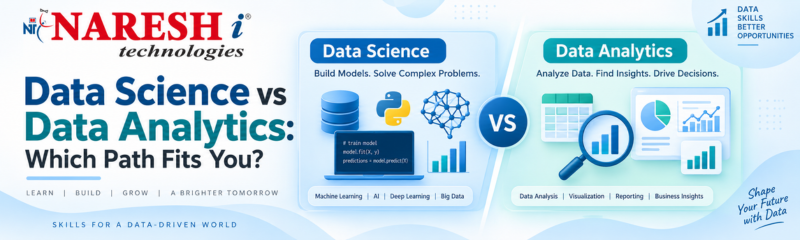
Data Science vs Data Analytics
| Question | Data Analytics | Data Science |
|---|---|---|
| Main purpose | Understand and explain data | Analyse data and build predictive solutions |
| Common questions | What happened? Why? | What may happen next? |
| Coding level | Beginner to intermediate | Intermediate to advanced |
| SQL | Very important | Very important |
| Python | Useful and increasingly common | Usually important |
| Statistics | Basic to intermediate | Intermediate to advanced |
| Dashboards | Common | Sometimes used |
| Machine Learning | Usually limited | Important |
| Typical output | Reports, dashboards, insights | Models, predictions, experiments |
| Beginner entry | Generally easier | Longer learning path |
This comparison is a general guide. Actual responsibilities differ from company to company.
What Is Data Analytics?
Data Analytics is the process of collecting, cleaning, examining and interpreting data to answer business questions.
- Suppose an online shopping company notices that its sales dropped in August.
- A Data Analyst may investigate questions such as:
- Why did sales decrease?
- Which product category was affected?
- Which city had the biggest decline?
- Did website traffic fall?
- Did customers abandon their carts?
- Which marketing channel generated fewer conversions?
- The analyst may use SQL to retrieve the required information, Excel or Python to clean it, and Power BI or Tableau to visualize the findings.
- Google describes Data Analysts as professionals who prepare, process and analyse data to help businesses make decisions and communicate findings through visualizations.
- The work is therefore not only about making charts.
- The real value comes from turning numbers into useful business information.
What Is Data Science?
Data Science covers data analysis but usually extends into statistical modelling, machine learning and predictive problem-solving.
Consider the same online shopping company.
Instead of only studying why customers stopped purchasing, a Data Scientist may try to build a model that predicts which customers are likely to stop buying in the future.
The process could involve:
- Collecting customer information.
- Cleaning and preparing the dataset.
- Studying important variables.
- Selecting a machine learning algorithm.
- Training the model.
- Evaluating its performance.
- Improving the model.
- Using the result in a real application.
Therefore, Data Science usually requires deeper programming and statistical knowledge.
A Simple Real-World Example
Imagine a food delivery company has data for one million orders.
A Data Analyst may answer:
- Which city generates the most orders?
- What is the average order value?
- At what time do most customers order?
- Which restaurant category is growing?
- Why did cancellations increase last month?
A Data Scientist may work on:
- Predicting delivery time.
- Predicting order cancellations.
- Creating restaurant recommendations.
- Detecting fraudulent transactions.
- Forecasting demand for different locations.
- The same dataset can therefore support both analytics and Data Science work.
- The difference is mainly the type of problem being solved.
Data Science vs Data Analytics: Skills Comparison
| Skill | Data Analyst | Data Scientist |
|---|---|---|
| Excel | High importance | Useful |
| SQL | High importance | High importance |
| Power BI/Tableau | High importance | Moderate |
| Python | Moderate to high | High |
| Pandas/NumPy | Useful | High |
| Statistics | Moderate | High |
| Data Visualization | High | High |
| Machine Learning | Basic/Optional | High |
| Deep Learning | Rarely required | Role dependent |
| Generative AI | Increasingly useful | Increasingly useful |
| Business Understanding | High | High |
| Model Deployment | Usually limited | Useful for advanced roles |
These are typical skill patterns rather than fixed rules. Job descriptions vary across organizations.
Which Is Easier for Beginners?
For many learners, Data Analytics is an easier starting point because it can begin with tools such as Excel, SQL and Power BI before moving into more programming.
Data Science generally adds another layer:
- Python programming
- Statistics
- Machine Learning
- Model evaluation
- Feature engineering
- Deployment concepts
- This does not mean a beginner cannot start directly with Data Science.
- It means the learning roadmap is usually longer.
For example, a B.Com graduate who has never programmed may first become comfortable with Excel, SQL and dashboards.
An engineering graduate who already understands programming may begin Python and machine learning sooner.
Your starting background changes the journey, not necessarily the destination.
What Should You Learn First?
- For beginners who are unsure between the two careers, a common foundation is useful.
- Start by understanding data and spreadsheets.
- Then learn SQL.
- Move into visualization and basic statistics.
- After that, start Python.
- At this stage, you can make a more informed career decision.
- If you enjoy dashboards, business questions and explaining trends, continue deeper into Data Analytics.
- If you enjoy programming, statistics, experimentation and predictive models, move further into Data Science.
Should You Learn Data Analytics Before Data Science?
You do not have to complete an entire Data Analytics course before learning Data Science.
However, analytical thinking is part of Data Science.
Before training a machine learning model, you must understand the data.
For example, you may need to answer:
- Are values missing?
- Are there duplicates?
- Are there extreme outliers?
- Which variables are related?
- Is the dataset balanced?
- Does the information make business sense?
- This is why learning data analysis fundamentals can make Machine Learning easier to understand.
Frequently Asked Questions
1. Is Data Science better than Data Analytics?
Neither is universally better. Data Analytics focuses more on understanding existing data, dashboards and business insights, while Data Science usually involves deeper programming, statistics and Machine Learning.
2. Which is easier for freshers: Data Science or Data Analytics?
Data Analytics is generally easier to start because beginners can begin with Excel, SQL and visualization tools. Data Science usually requires additional knowledge of Python, statistics and Machine Learning.
3. Which requires more coding: Data Science or Data Analytics?
Data Science generally requires more coding. Python is widely used in Data Science, while Data Analysts often work heavily with SQL and may also use Python depending on the role.
4. Can a Data Analyst become a Data Scientist?
Yes. A Data Analyst can move into Data Science by developing stronger skills in Python, statistics, Machine Learning, model evaluation and project building.
5. Do I need mathematics for Data Analytics?
Basic mathematics and statistics are useful for Data Analytics. Advanced mathematics is usually less important than it is in some Data Science and Machine Learning roles.
6. Is SQL enough to get a Data Analytics job?
SQL is an important skill, but employers may also expect Excel, Power BI or Tableau, data visualization, analytical thinking and communication skills.
7. Should I learn Power BI or Python first?
If your goal is Data Analytics, you can begin with SQL and Power BI. If your goal is Data Science, Python should become an important part of your learning path.
8. Can non-IT students learn Data Science or Data Analytics?
Yes. Students from non-IT backgrounds can learn both fields. They may need additional practice with programming, statistics and technical tools.
9. Which career is better for someone who likes dashboards and reports?
Data Analytics may be a better fit for someone who enjoys dashboards, reporting, business insights and working with tools such as SQL, Excel and Power BI.
10. Which career is better for someone interested in Machine Learning?
Data Science may be more suitable because it usually includes Machine Learning, predictive modelling, Python and statistical analysis.
11. Will AI replace Data Analysts and Data Scientists?
AI can automate parts of data analysis and coding, but professionals still need to understand business problems, validate results, work with data quality and make decisions based on context.
12. Can I start with Data Analytics and later move into Data Science?
Yes. This is a practical path for many beginners because Data Analytics helps build strong foundations in SQL, data cleaning, visualization and business understanding before moving into Machine Learning.
Learning Data Science and Data Analytics in KPHB
Students looking for Data Science training in KPHB should evaluate more than the course name.
Look at the syllabus, practical sessions, trainer experience, projects, lab access, doubt support and placement preparation.
At NareshIT, learners can build their skills through structured technical training, practical lab work, experienced trainers and technology-focused mentor support.
Beginners should focus on developing skills step by step instead of rushing directly into advanced tools.
The goal should not simply be completing a course.
The goal should be becoming capable of solving a data problem independently.