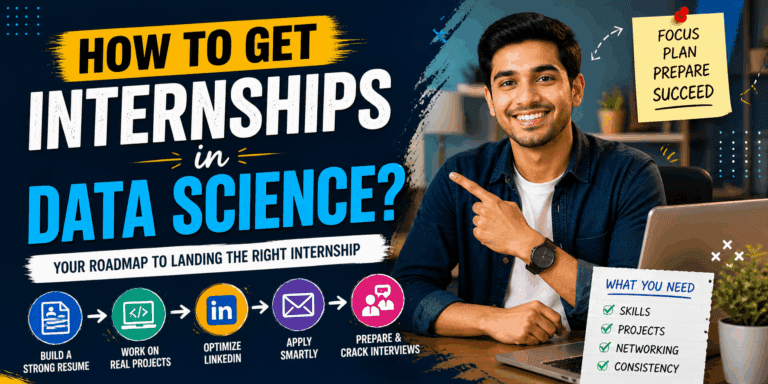
Introduction
If you’re searching how to get internships in data science, you need to understand one thing first:
👉 Internships are not given to learners
👉 They are given to problem-solvers with proof
So your goal is not “apply more.”
Your goal is: become someone worth selecting
Let’s fix that.
What Companies Expect from Data Science Interns
You’re not expected to be an expert. Relax.
But you are expected to have:
- Basic Python knowledge
- SQL fundamentals
- Understanding of data cleaning
- Simple machine learning concepts
- Ability to explain your work
Basically: not clueless.
Step-by-Step: How to Get Internships in Data Science
1. Build 2–3 Strong Projects First
Before applying anywhere:
👉 Build projects
Minimum Projects:
- Sales prediction
- Customer segmentation
- Recommendation system
What Makes a Good Project:
- Real dataset
- Clear problem
- Data cleaning
- Model building
- Results explanation
If your project is “run notebook → accuracy → done”… you’re not ready.
2. Create a Strong Resume
Your resume should show:
- Skills (Python, SQL, ML)
- Projects
- Tools (Power BI, Excel)
- GitHub link
Keep it 1 page. No drama.
3. Optimize Your GitHub
This is where most people embarrass themselves.
Your GitHub Should Have:
- Clean repositories
- README with explanation
- Proper file structure
- Visual outputs
👉 Recruiters check this silently.
4. Apply Smart (Not Randomly)
Stop mass applying like it’s a lottery.
Apply On:
- LinkedIn Jobs
- Internshala
- Naukri
- Company career pages
Target Roles:
- Data Analyst Intern
- ML Intern
- AI Intern
- Business Analyst Intern
5. Use LinkedIn Networking (Critical)
This is where jobs actually happen.
Do This:
- Connect with recruiters
- Message employees
- Ask for referrals
- Engage with posts
Example Message:
“Hi, I’m a data science learner with projects in ML and analytics. I’m looking for internship opportunities. Would appreciate any guidance or referrals.”
Simple. Not cringe.
6. Prepare for Interviews
Even internship interviews test basics.
Prepare:
- Python questions
- SQL queries
- ML concepts
- Project explanation
👉 If you can’t explain your project, you don’t have a project.
7. Do Small Freelance or Internship Work
No experience?
Create it.
- Work with small businesses
- Analyze datasets
- Do unpaid short projects (strategically)
One real project > 10 fake ones.
Where to Find Data Science Internships
Platforms:
- Internshala
- AngelList (Startups)
- Indeed
- Company websites
Cities with More Opportunities:
- Hyderabad
- Bengaluru
- Pune
- Chennai
- Gurgaon
Hyderabad is strong due to training + placement ecosystem.
Skills That Increase Internship Chances
Focus on:
- Python
- SQL
- Pandas / NumPy
- Machine Learning basics
- Power BI / Tableau
- Statistics
Bonus:
- NLP
- Deep learning
- Cloud basics
Skills Required for Data Science Internships
Skill Distribution
| Skill Area | Percentage |
|---|---|
| Python Programming | 25% |
| SQL & Databases | 20% |
| Machine Learning | 20% |
| Statistics | 15% |
| Data Visualization | 10% |
| Communication Skills | 10% |
Common Mistakes
Stop doing these:
- Applying without projects
- No GitHub
- Weak resume
- No networking
- Ignoring SQL
- Copy-paste learning
This is why people stay stuck.
How Long Does It Take to Get an Internship?
Realistically:
- 1–2 months (if prepared well)
- 3–6 months (if starting from scratch)
Consistency matters more than intensity.
Conclusion
If you’re serious about how to get internships in data science, focus on:
- Projects
- Resume
- GitHub
- Networking
- Interview preparation
And if you want structured training, real-time projects, and placement-focused preparation, many learners choose Naresh IT to build internship-ready skills.
Which is better than guessing your way through everything.
FAQs
1. Can beginners get data science internships?
Yes, with strong projects and basic skills.
2. Are internships paid?
Some are paid, some unpaid (choose wisely).
3. Is coding required?
Yes, Python and SQL are important.
4. How many projects are needed?
2–3 strong projects are enough.
5. Do certifications help?
Yes, but projects matter more.