Students exploring careers in data often hear about Data Scientists, but another important role appears frequently in job descriptions: Data Engineer.
Both professionals work with data, but they usually work on different parts of the data journey.
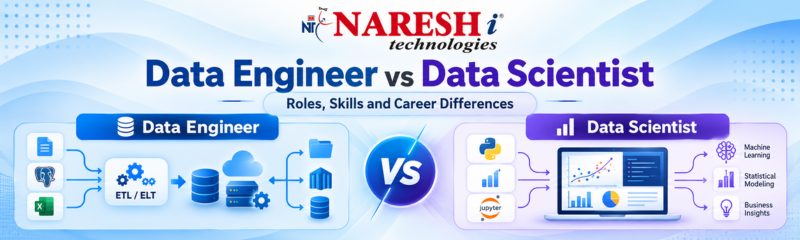
A Data Engineer builds the systems that collect, store and move data.
A Data Scientist uses that data to analyse patterns, answer questions and build predictive models.
A simple way to understand the difference is:
Data Engineer → Makes data available and reliable
Data Scientist → Uses data to generate insights and predictions
Both roles can be part of the same project, and one often depends on the other.
Data Engineer vs Data Scientist: Quick Comparison
| Area | Data Engineer | Data Scientist |
|---|---|---|
| Main Focus | Build data systems | Analyse data and build models |
| SQL | Very Important | Very Important |
| Python | Very Important | Very Important |
| Statistics | Limited to Moderate | Very Important |
| Databases | Very Important | Important |
| Cloud | Very Important | Useful |
| Data Pipelines | Core Skill | Usually not core |
| Machine Learning | Limited | Important |
| Data Visualization | Limited | Important |
| ETL/ELT | Core Skill | Basic understanding |
| Business Analysis | Moderate | Important |
| Big Data Tools | Important | Role dependent |
What Does a Data Engineer Do?
A Data Engineer creates and maintains the infrastructure used to work with data.
Imagine an e-commerce company that collects information from:
- Website activity
- Mobile applications
- Customer purchases
- Payment systems
- Product databases
- Marketing platforms
All this information may come from different sources.
The Data Engineer’s job is to make sure the data reaches the right place in a clean and usable format.
Typical responsibilities can include:
- Building data pipelines
- Managing databases
- Cleaning and transforming large datasets
- Moving data between systems
- Working with cloud platforms
- Maintaining data warehouses
- Monitoring pipeline failures
- Improving data quality
Without reliable data infrastructure, analysts and Data Scientists may not have good-quality information to work with.
Simple Real-World Example
Consider a food delivery company.
Data Engineer
The Data Engineer may build systems that combine:
- Order data
- Customer data
- Restaurant data
- Payment data
- Delivery-partner information
- App activity
- The engineer makes sure this information is stored correctly and updated regularly.
Data Engineer vs Data Scientist: Skills Comparison
Which Role Requires More Coding?
Both roles involve coding, but the type of coding is different.
A Data Engineer may write code to:
- Move data between systems
- Transform datasets
- Automate pipelines
- Connect databases
- Process large amounts of data
A Data Scientist may write code to:
- Analyse datasets
- Perform statistical calculations
- Train Machine Learning models
- Evaluate predictions
- Create experiments
So:
- Data Engineering coding focuses on data infrastructure.
- Data Science coding focuses on analysis and modelling.
Which Role Requires More SQL?
SQL is extremely important for both.
However, Data Engineers may work even more deeply with databases because they are responsible for designing and maintaining data systems.
They may work with:
- Relational databases
- Data warehouses
- Cloud databases
- Data lakes
- Large-scale processing systems
Data Scientists also use SQL frequently to retrieve information for analysis.
Which Role Requires More Mathematics?
Data Science generally requires more mathematics and statistics.
A Data Scientist may need to understand:
- Probability
- Statistics
- Correlation
- Regression
- Hypothesis testing
- Model evaluation
A Data Engineer needs strong logical thinking and programming skills, but advanced statistics is usually less central to the role.
Data Engineer Learning Path
A beginner interested in Data Engineering can follow a path like this:
1. SQL
Build strong database-querying skills.
2. Python
Learn programming and data processing.
3. Databases
Understand relational and NoSQL databases.
4. ETL and ELT
Learn how data is extracted, transformed and loaded.
5. Data Warehousing
Understand how organisations store analytical data.
6. Cloud
Learn platforms such as AWS, Azure or Google Cloud.
7. Big Data
Explore tools used for processing large datasets.
8. Data Pipelines
Learn how to automate data movement and transformation.
What Projects Can Beginners Build?
Data Engineering Projects
Beginners can try:
- Build an ETL pipeline
- Move CSV data into a database
- Create a simple data warehouse
- Build an automated data-cleaning pipeline
- Create a cloud-based data pipeline
Can a Data Engineer Become a Data Scientist?
Yes.
Both roles share skills such as Python, SQL and data handling.
A Data Engineer who wants to move into Data Science can strengthen:
- Statistics
- Data visualization
- Exploratory Data Analysis
- Machine Learning
- Model evaluation
Similarly, a Data Scientist can move toward Data Engineering by learning databases, cloud, pipelines and data architecture.
Career paths are flexible.
Frequently Asked Questions
1. What is the main difference between a Data Engineer and Data Scientist?
A Data Engineer builds systems that collect, store and process data, while a Data Scientist uses that data for analysis, insights and predictive modelling.
2. Which career needs more SQL?
Both require SQL, but Data Engineers often work more deeply with databases and data warehouses.
3. Which career needs more mathematics?
Data Science generally requires stronger mathematics and statistics.
4. Which career uses more cloud technology?
Data Engineering usually involves more cloud infrastructure, storage and data pipeline work.
5. Can freshers become Data Engineers?
Yes. Freshers can start by learning SQL, Python, databases, ETL concepts and cloud fundamentals.
6. Can a Data Engineer become a Data Scientist?
Yes. Additional skills in statistics, Machine Learning and data analysis can support the transition.
7. Does a Data Scientist need Data Engineering knowledge?
Basic Data Engineering knowledge can be useful because Data Scientists often work with databases, cloud data and pipelines.
8. Which career is better for someone who likes databases?
Data Engineering may be more suitable because databases and data infrastructure are central to the role.
9. Which career is better for Machine Learning?
Data Science is more directly connected with Machine Learning and predictive modelling.
10. Can non-IT students become Data Engineers?
Yes, but they should build strong programming, SQL, database and cloud fundamentals.
Final Thoughts
The Data Engineer vs Data Scientist comparison becomes easy when you think about the data journey.
A Data Engineer focuses on:
Collect → Store → Transform → Move → Maintain
A Data Scientist focuses on:
Explore → Analyse → Model → Predict → Explain
Both careers are important.
If you enjoy databases, cloud platforms and building technical data systems, Data Engineering may suit you.If you enjoy statistics, analysis, Machine Learning and finding patterns, Data Science may be a better fit.For beginners, start with the common foundation:
Python + SQL + Data Fundamentals
Then explore projects from both fields before deciding which direction you enjoy more.