A student interested in data careers will often come across two job titles first: Data Analyst and Data Scientist.
Both professionals work with data. Both may use SQL, Python, statistics and visualization tools. However, their day-to-day responsibilities can be different.
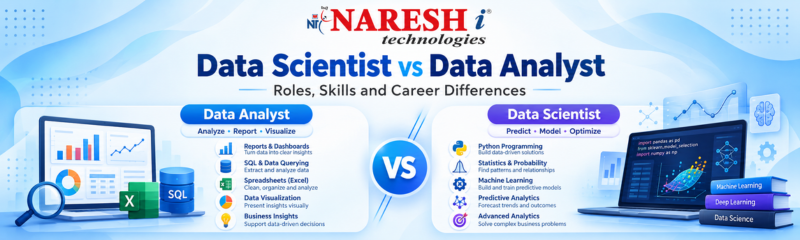
A Data Analyst generally studies existing data to identify trends, answer business questions and create reports or dashboards.
A Data Scientist often goes further by using programming, statistics and Machine Learning to build predictive models and solve more complex data problems.
So when comparing Data Scientist vs Data Analyst, the main question is not which career is better.
The better question is:
Which type of work matches your interests and current skills?
Data Scientist vs Data Analyst: Quick Comparison
| Area | Data Analyst | Data Scientist |
|---|---|---|
| Main Focus | Understand existing data | Analyse data and build predictive solutions |
| Common Question | What happened and why? | What may happen next? |
| SQL | Very Important | Very Important |
| Excel | Very Important | Useful |
| Power BI/Tableau | Common | Useful |
| Python | Useful to Important | Very Important |
| Statistics | Important | Very Important |
| Machine Learning | Usually limited | Common |
| Dashboard Creation | Common | Sometimes |
| Model Building | Limited | Common |
| Business Communication | Very Important | Very Important |
What Does a Data Analyst Do?
A Data Analyst helps organisations understand what their existing data is telling them.
Imagine a retail company wants to know why sales declined last month.
A Data Analyst may investigate:
- Which products had lower sales?
- Which region performed poorly?
- Did customer traffic decrease?
- Which marketing campaign performed best?
- Did returning customers purchase less?
The analyst may use SQL to retrieve data, Excel or Python to clean it, and Power BI or Tableau to create visual reports.
The final goal is usually to turn raw numbers into information that decision-makers can understand.
Common Data Analyst responsibilities include:
- Collecting and cleaning data
- Writing SQL queries
- Preparing reports
- Creating dashboards
- Identifying trends
- Tracking KPIs
- Presenting findings
- Supporting business decisions
A strong Data Analyst needs both technical ability and business understanding.
A Simple Real-World Example
A Data Analyst may study:
- Orders per city
- Average delivery time
- Monthly revenue
- Customer complaints
- Restaurant performance
- Peak ordering hours
The analyst may create a dashboard for management.
Data Analyst vs Data Scientist: Skills Comparison
| Skill | Data Analyst | Data Scientist |
|---|---|---|
| Excel | High | Medium |
| SQL | High | High |
| Power BI/Tableau | High | Medium |
| Python | Medium | High |
| Pandas | Medium | High |
| Statistics | Medium | High |
| Data Visualization | High | High |
| Machine Learning | Low to Medium | High |
| Feature Engineering | Limited | High |
| Model Evaluation | Limited | High |
| Business Understanding | High | High |
| Communication | High | High |
Can a Data Analyst Become a Data Scientist?
A Data Analyst already develops several useful skills:
- SQL
- Data cleaning
- Visualization
- Business understanding
- Exploratory analysis
To move toward Data Science, the learner can strengthen:
- Python
- Statistics
- Machine Learning
- Feature engineering
- Model evaluation
- Project development
This is a common and practical progression.
What Projects Should Freshers Build?
Data Analyst projects
Freshers can build:
- Sales dashboard
- E-commerce analysis
- Marketing performance dashboard
- HR analytics dashboard
- Customer segmentation report
Data Science projects
Useful beginner projects include:
- Customer churn prediction
- House price prediction
- Loan default prediction
- Sales forecasting
- Recommendation system
- Sentiment analysis
The project should demonstrate your thinking.
Do not just upload code.
Explain the problem, data, method and result.
Frequently Asked Questions
1. What is the main difference between a Data Analyst and Data Scientist?
A Data Analyst primarily examines existing data and communicates insights, while a Data Scientist often uses advanced statistics and Machine Learning to build predictive models.
2. Which is easier for beginners?
Data Analytics usually has a lower technical entry barrier because learners can begin with Excel, SQL and visualization tools.
3. Who needs more coding?
Data Scientists generally use more programming, particularly Python. Data Analysts also use SQL heavily and may use Python.
4. Can a fresher become a Data Scientist?
Yes, but freshers should build strong Python, SQL, statistics, Machine Learning and project skills.
5. Can a Data Analyst become a Data Scientist?
Yes. Analysts can transition by learning deeper statistics, Python, Machine Learning and model-building skills.
6. Is SQL important for Data Scientists?
Yes. Data Scientists often need SQL because real-world information is commonly stored in databases.
7. Does a Data Analyst need Python?
Not every entry-level role requires Python, but learning it can expand the type of analysis you can perform.
8. Is Power BI useful for Data Scientists?
Power BI is not a Machine Learning tool, but it can be useful for visualizing and communicating data insights.
9. Which role is better for someone interested in Machine Learning?
Data Science is usually more closely connected with Machine Learning.
10. Can non-IT students enter these careers?
Yes. Learners from different educational backgrounds can enter data careers by developing the required technical and analytical skills.
Final Thoughts
The Data Scientist vs Data Analyst comparison becomes simpler when you look at the type of work each role performs.
A Data Analyst usually focuses on:
Data → Analysis → Visualization → Business Insights
A Data Scientist often continues further:
Data → Analysis → Statistics → Machine Learning → Prediction
For beginners, Data Analytics can be a practical entry point.
For students who enjoy Python, statistics and Machine Learning, Data Science may be the path they want to explore more deeply.
Whichever route you choose, focus on practical skills rather than only job titles.
Learn the fundamentals, work with real datasets and build projects you can confidently explain.