Introduction
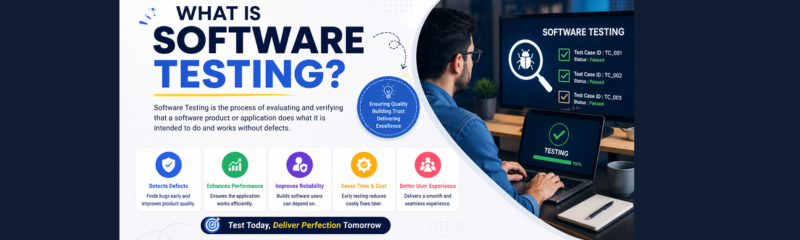
Software testing is the process of verifying and validating software applications to ensure they work correctly, securely, efficiently, and without critical errors before reaching users.
In 2026, software testing has become one of the most important parts of software development because businesses depend heavily on:
- Web applications
- Mobile applications
- Cloud platforms
- AI systems
- Banking applications
- E-commerce platforms
Even a small software bug can cause:
- Financial losses
- Security breaches
- Poor user experience
- Application crashes
Which is why software testers are essentially professional detectives who spend their careers proving developers were “technically wrong.” A noble and exhausting profession.
Why Software Testing is Important
Without proper software testing:
- Applications may crash
- User data may leak
- Payments may fail
- Performance may become slow
- Security vulnerabilities may appear
Testing helps organizations:
- Improve software quality
- Reduce production errors
- Enhance customer satisfaction
- Ensure application reliability
- Save long-term maintenance costs
Modern companies now consider software testing a critical part of:
- DevOps
- Agile development
- CI/CD pipelines
- Cloud deployment
- AI application delivery
Software Testing in the Modern IT Industry
| Industry | Testing Usage |
|---|---|
| Banking | Secure transaction validation |
| Healthcare | Patient data security |
| E-commerce | Payment and checkout testing |
| AI Applications | Model accuracy validation |
| Cloud Computing | Infrastructure testing |
| Telecom | Performance and load testing |
Types of Software Testing
Types of Software Testing
Software testing is mainly divided into two categories:
- Manual Testing
- Automation Testing
1. Manual Software Testing
What is Manual Testing?
Manual testing involves testing software applications manually without using automation tools.
Testers:
- Execute test cases
- Identify bugs
- Validate features
- Report issues
Example:
A tester manually checks:
- Login functionality
- Payment systems
- Navigation menus
- Form validations
Skills Required:
- Analytical thinking
- Attention to detail
- Communication skills
- Understanding of SDLC and STLC
Advantages:
- Human observation
- Better usability testing
- Flexible testing approach
Limitations:
- Time-consuming
- Repetitive tasks
- Less efficient for large projects
2. Automation Software Testing
What is Automation Testing?
Automation testing uses tools and scripts to automatically execute test cases.
Popular Automation Tools:
- Selenium
- Cypress
- Playwright
- TestNG
- JUnit
Benefits:
- Faster execution
- Reusable scripts
- Better regression testing
- Improved efficiency
Industry Demand:
Automation testing demand is growing rapidly because companies need:
- Faster releases
- CI/CD integration
- Scalable testing workflows
Manual Testing vs Automation Testing
| Feature | Manual Testing | Automation Testing |
|---|---|---|
| Execution | Human-driven | Tool-driven |
| Speed | Slower | Faster |
| Accuracy | Moderate | High |
| Cost | Lower initially | Higher initially |
| Reusability | Limited | High |
| Best For | Exploratory testing | Regression testing |
Software Testing Life Cycle (STLC)
The Software Testing Life Cycle includes:
1. Requirement Analysis
Understanding project requirements.
2. Test Planning
Creating testing strategies and timelines.
3. Test Case Development
Writing detailed test cases.
4. Environment Setup
Preparing testing environments.
5. Test Execution
Running test cases and identifying defects.
6. Defect Reporting
Logging bugs in tracking systems.
7. Test Closure
Preparing final testing reports.
Important Software Testing Concepts
Functional Testing
Checks whether software functions properly.
Examples:
- Login testing
- Registration testing
- Payment testing
Non-Functional Testing
Checks:
- Performance
- Scalability
- Security
- Reliability
Regression Testing
Ensures new updates do not break existing features.
Developers call this:
“Everything worked yesterday.”
Testers call this:
“Prove it.”
Smoke Testing
Basic testing to check whether the application is stable.
Performance Testing
Evaluates:
- Speed
- Scalability
- Load handling
Tools:
- JMeter
- LoadRunner
Security Testing
Identifies:
- Vulnerabilities
- Data leaks
- Authentication weaknesses
Very important in:
- Banking
- Healthcare
- Cloud applications
Top Software Testing Tools in 2026
| Tool | Purpose |
|---|---|
| Selenium | Web automation |
| Cypress | Frontend testing |
| Playwright | Modern automation |
| JMeter | Performance testing |
| Postman | API testing |
| Appium | Mobile testing |
Software Testing and DevOps
Modern DevOps workflows heavily depend on testing.
Testing helps:
- Faster deployment
- Continuous integration
- Continuous delivery
- Stable releases
DevOps + Testing = Faster Software Delivery
Role of AI in Software Testing
AI-powered testing is rapidly growing in 2026.
AI Testing Capabilities:
- Self-healing test scripts
- Intelligent bug prediction
- Automated test generation
- Visual testing automation
Trending Technologies:
- AI Test Automation
- Generative AI Testing
- Predictive Analytics
Software Testing Market Demand in 2026
| Testing Area | Percentage |
|---|---|
| Automation Testing | 40% |
| Manual Testing | 20% |
| API Testing | 15% |
| Performance Testing | 10% |
| Security Testing | 10% |
| AI Testing | 5% |
Career Opportunities in Software Testing
| Role | Average Salary in India |
|---|---|
| Manual Tester | ₹3–5 LPA |
| Automation Tester | ₹5–10 LPA |
| QA Engineer | ₹6–12 LPA |
| SDET | ₹10–20 LPA |
| Performance Tester | ₹7–15 LPA |
Skills Required for Software Testing
Technical Skills:
- Manual testing
- Automation tools
- SQL
- API testing
- Programming basics
Soft Skills:
- Communication
- Problem-solving
- Analytical thinking
- Attention to detail
Software Testing Interview Questions
Common interview topics include:
- SDLC vs STLC
- Defect life cycle
- Test case writing
- Selenium concepts
- API testing basics
- SQL queries
Important Observation:
Interviewers often focus heavily on practical scenarios rather than textbook definitions.
Because anyone can memorize:
“Testing is the process of validating software…”
But explaining why the checkout page crashes only in Firefox after midnight?
That is true industry enlightenment.
How Beginners Can Learn Software Testing
Step-by-Step Learning Path:
- Learn SDLC and STLC
- Understand manual testing concepts
- Learn test case writing
- Practice bug reporting
- Learn Selenium automation
- Understand API testing
- Practice real-time projects
Importance of Practical Training
Many students struggle because they learn only theory.
Practical training helps students:
- Work on live projects
- Understand industry tools
- Build interview confidence
- Learn automation frameworks
NareshIT provides practical training in:
- Software Testing
- Selenium Automation
- API Testing
- DevOps
- Cloud Computing
- Full Stack Development
with real-time trainers, mentor support, live projects, and placement-focused training.
Future of Software Testing
The future of software testing is strongly connected with:
- AI automation
- Cloud platforms
- DevOps
- Continuous testing
- Security testing
Companies increasingly demand testers who understand:
- Automation frameworks
- CI/CD pipelines
- Cloud infrastructure
- AI-assisted testing
.
Conclusion
Software testing is one of the most important processes in software development because it ensures applications are reliable, secure, and user-friendly before deployment.
In 2026, software testing continues to evolve with:
- Automation testing
- AI-powered testing
- DevOps integration
- Cloud testing
Students and professionals who learn practical testing skills can build strong careers in the growing QA and software engineering industry.
FAQs
1. What is software testing in simple words?
Software testing is the process of checking applications for bugs, errors, and performance issues.
2. What are the types of software testing?
The two major types are manual testing and automation testing.
3. Is software testing a good career in 2026?
Yes, software testing remains highly in demand due to DevOps, cloud computing, and AI applications.
4. Which tool is best for automation testing?
Selenium is one of the most popular automation testing tools.
5. Can freshers learn software testing easily?
Yes, beginners can start with manual testing and gradually move into automation testing.