Introduction
Many students today hear terms like cloud computing, virtual servers and online storage, but they still wonder what the cloud actually is and how it works. It is important to understand this concept because most modern technologies – including software development, automation, and DevOps training, especially DevOps with AWS training, rely on cloud platforms. How clod works Students planning a career in IT, whether they want DevOps jobs for newcomers in India, cloud roles or full-stack development positions, should learn how the cloud works behind the scenes.
What Is Cloud Computing?
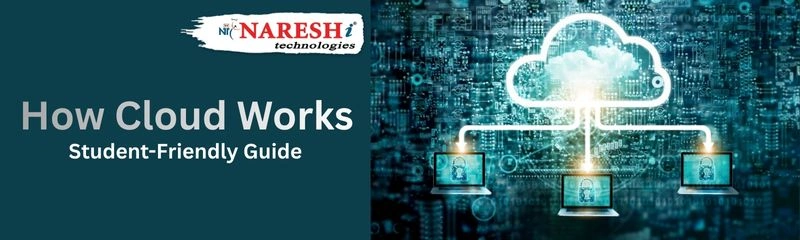
Cloud computing refers to delivering computing services over the internet. Instead of students depending on expensive computers or physical servers, cloud providers offer virtual machines, databases, storage, and more. These resources run inside huge data centers located around the world.
Cloud platforms power most modern applications — from social media to online learning platforms. That is why students who take DevOps courses for beginners, devops with multi-cloud training, or DevOps practical training quickly realize that cloud is at the core of everything.
Why is the cloud important for students?
Students entering the technology industry benefit greatly from understanding the fundamentals of the cloud:
- It improves job opportunities, especially for workers and newcomers to DevOps.
- . It supports flexible learning, allowing students to learn DevOps online from anywhere.
- It helps students understand the real workflow in the industry.
- It supports hands-on experience with scalable environments.
- It makes it easier to practice on tools required for the top DevOps certification course.
Many companies today hire candidates who understand at least one cloud platform. So learning about the cloud boosts confidence, practical skills, and employment readiness.
When do companies use cloud computing?
Organizations rely on cloud computing in many situations:
1.Launch apps speedy
Businesses don’t want to attend months to installation a server. The cloud allows them to launch apps immediately.
2.Management of heavy traffic
Online examination portals, e-trade sites and streaming platforms frequently experience unexpected spikes in site visitors. Cloud servers are robotically large.
3.Storage and analysis of big data
Data-driven services rely on cloud-based storage and analysis tools.
4. Implementing DevOps Pipelines
Cloud computing is essential for CI/CD pipelines used in NareshIT DevOps training, because it offers automation, deployment platforms, and monitoring tools.
5.Supporting Remote Work
Employees anywhere in the world can access applications securely.
This flexibility explains why companies prefer hiring students who understand cloud workflows and DevOps tools.
Where the clouds sincerely roam
Although the cloud appears virtual, it on the whole runs on physical infrastructure. These include:
statistics center
Huge homes packed with servers, cooling structures, community gadgets and backup energy.
Server rack
Rows of immoderate-standard performance machines jogging cloud workloads.
Security Layers
Firewalls, encryption systems, access control, and threat monitoring protect data.
Students learn about these environments in DevOps classes near me and multi-cloud modules, which help them understand how real companies manage IT infrastructure.
Who Uses Cloud Computing?
Cloud computing caters to a wide range of users:
- Students learning programming, AI, data science, Linux, and DevOps.
- Startups that want low-cost infrastructure.
- Large enterprises building scalable software.
- Developers testing and deploying applications.
- DevOps engineers running automated pipelines using AWS, Azure or Google Cloud.
Even everyday users rely on cloud storage for photos, documents, and videos.
How the cloud works - Simple step-by-step process for students
It becomes easier to understand how the cloud works when it is broken down into steps:
1.A user sends a request
This can be a login request, open a program, upload a file or run a program.
2.The request reaches the cloud server
The user’s request goes via the Internet to the nearest cloud data center.
3.Server processes the request
A virtual machine, container, or application handles the request immediately.
4.Server sends back response
This could be:
- load a web page
- a video is playing
- A file is saved
- An app is being updated
This entire process happens within milliseconds.
5.Automated Scaling and Monitoring
When traffic increases, the cloud automatically creates more servers. This is how cloud works is vital in DevOps learning roadmap and DevOps practical training.
Types of Cloud Services Students Should Know
Understanding service types helps students choose the right IT career path.
Infrastructure as a Service
Students get virtual servers, networks, and storage. Ideal for those learning DevOps with AWS training.
Platform as a Service
Developers build and deploy apps without managing servers.
Software as a Service
Users access software directly over the internet.
These concepts are essential for DevOps training with placement assistance because most companies use these service models daily.
Major cloud deployment models
There are three common deployment options:
Public cloud – services shared between users.
Private cloud – dedicated to a single organization.
Hybrid/Multi-Cloud – A combination of multiple cloud platforms, important for developers with multi-cloud training.
Real use cases students can understand
online learning platform
They host videos, run live courses, store student presentations and handle heavy traffic loads.
Banking apps
They use stable cloud systems for on line transactions and verification.
Social media applications
Billions of picture uploads run on disbursed cloud servers every day.
Play online
Games rely on cloud servers for clean overall performance and global reach.
These sensible examples assist college students apprehend the value of the cloud in a real IT surroundings.
Common questions requested through students about cloud computing
1. Is the cloud safe to store facts?
Yes. Cloud providers use encryption, access manage and monitoring systems to defend data.
2. Can beginners learn cloud easily?
Absolutely. Many students start with the basic modules and move on to DevOps courses for beginners.
3. What Skills Should Students Learn First?
Linux basics, networking, version control, and cloud fundamentals are important.
4. How does the cloud help in DevOps?
Automates cloud deployment, testing, scaling and monitoring – core elements of MonarchIT DevOps training.
5. Does cloud computing improve job opportunities?
Yes. Companies are looking for candidates who understand AWS, Azure and DevOps tools. Many freshers secure roles through DevOps jobs for freshers in India.
How college students can start learning Cloud and DevOps
Students can start with:
- Basics of Cloud Platform
- Administration of virtual machines
- Network fundamentals
- CI/CD pipeline
- Scripting
- Containers and Kubernetes
- Multi-Cloud concepts
Those planning a profession in automation need to discover the best DevOps certification publications as they offer actual-time experience and sturdy placement help.
Conclusion
Understanding how the cloud works is step one toward mastering modern-day IT technologies. Students aiming to pursue careers in improvement, automation or cloud operations advantage substantially from dependent, palms-on training. Learning the cloud also strengthens talents in deployment, tracking and scaling – essential in today’s digital global. Anyone making plans to grow within the era enterprise can begin their journey with palms-on cloud modules and complete DevOps education to construct a robust basis.