Introduction
If you want to learn data science step by step, this guide will provide a structured, industry-oriented roadmap designed for beginners and working professionals. Data science is an interdisciplinary domain combining statistics, programming, and machine learning to extract meaningful insights from data. With the rapid growth of AI-driven technologies in 2026, mastering data science has become essential for building a high-impact tech career.
How to Learn Data Science Step by Step for Beginners
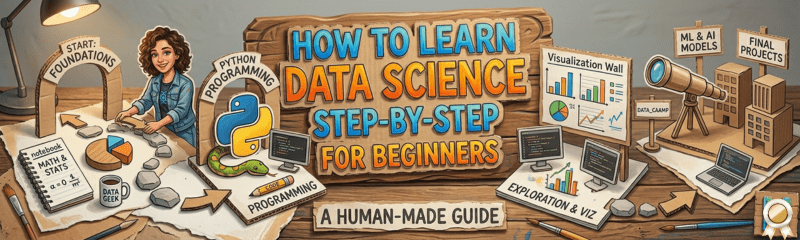
Step 1: Mathematical & Statistical Foundations (Core Layer)
To truly learn data science step by step, mathematics is not optional—it is fundamental.
Key Concepts:
- Linear Algebra → vectors, eigenvalues, matrix operations
- Probability Theory → Bayes theorem, distributions
- Statistics → hypothesis testing, confidence intervals
- Calculus → gradient descent, optimization
Why it matters:
Machine learning models like regression and neural networks rely heavily on these concepts.
Step 2: Programming with Python (Industry Standard)
Python dominates the data science ecosystem due to its scalability and rich libraries.
Core Stack:
- NumPy → high-performance numerical computing
- Pandas → data manipulation and transformation
- Matplotlib / Seaborn → visualization
- SciPy → scientific computing
Advanced Tools:
- Polars (high-performance DataFrame alternative)
- Dask (parallel computing)
Focus on:
- Writing vectorized code
- Memory optimization
- Clean architecture
Step 3: Data Wrangling & Exploratory Data Analysis (EDA)
Before modeling, data must be understood and cleaned.
Techniques:
- Handling missing values (imputation strategies)
- Outlier detection (Z-score, IQR)
- Feature engineering
- Data normalization & scaling
Visualization:
- Histograms, boxplots
- Correlation heatmaps
- Time-series plots
Insight:
80% of a data scientist’s time is spent here.
Step 4: SQL & Data Engineering Basics
Modern data science requires working with large-scale databases.
Must-Know:
- Complex joins
- Window functions
- Query optimization
Advanced:
- Data Warehousing (Snowflake, BigQuery)
- ETL pipelines
- Data lakes
Step 5: Machine Learning (Core Engine)
This is where predictive intelligence begins.
Supervised Learning:
- Linear/Logistic Regression
- Decision Trees
- Random Forest
- Gradient Boosting (XGBoost, LightGBM)
Unsupervised Learning:
- K-Means Clustering
- Hierarchical Clustering
- PCA (Dimensionality Reduction)
Model Evaluation:
- Accuracy, Precision, Recall
- ROC-AUC
- Cross-validation
Step 6: Deep Learning & AI (2026 Industry Standard)
To stay relevant, you must go beyond traditional ML.
Key Areas:
- Neural Networks (ANN, CNN, RNN)
- Transformers (used in modern AI systems)
- Generative AI (LLMs, diffusion models)
Tools:
- TensorFlow
- PyTorch
Step 7: Real-World Projects (Critical for Jobs)
To learn data science step by step effectively, projects are non-negotiable.
High-Impact Projects:
- End-to-end ML pipeline (data → deployment)
- Recommendation system
- NLP chatbot
- Time-series forecasting
Include:
- Problem statement
- Data preprocessing
- Model building
- Deployment
Step 8: MLOps & Deployment (Advanced Level)
Most beginners skip this — professionals don’t.
Learn:
- Model deployment (Flask, FastAPI)
- Docker & Kubernetes
- CI/CD pipelines
- Model monitoring
Step 9: Portfolio & Personal Branding
To stand out:
- Build GitHub projects
- Write technical blogs
- Participate in Kaggle competitions
- Optimize LinkedIn profile
Advanced Learning Strategy
To truly master data science:
- Follow project-first learning
- Focus on problem-solving, not just theory
- Learn how models fail, not just how they work
- Study real business use-cases
Common Mistakes to Avoid
- Learning tools without understanding concepts
- Ignoring mathematics
- Not working on real datasets
- Skipping deployment
- Over-relying on tutorials
Conclusion :
To successfully learn data science step by step, you need more than just theoretical knowledge—you need a structured roadmap, hands-on projects, and real-world exposure. From mastering Python and statistics to building machine learning models and deploying them, every stage plays a critical role in shaping you into a job-ready data scientist.
However, one of the biggest challenges learners face is choosing the right platform that provides industry-oriented training, mentorship, and practical implementation. This is where a well-structured training institute can make a significant difference. Platforms that focus on real-time projects, expert-led sessions, and career support help bridge the gap between learning and employment.
If you are serious about building a career in data science, choosing a reliable training institute like Naresh IT can accelerate your learning journey. With a strong focus on practical skills, updated curriculum (2026 trends), and placement-oriented training, it provides the kind of environment required to truly master data science step by step.
FAQs – Learn Data Science Step by Step
1. Can I learn data science step by step without a programming background?
Yes, you can learn data science step by step even without prior programming experience. Start with Python basics, then gradually move to data analysis, visualization, and machine learning. A structured roadmap and consistent practice are key to mastering the concepts efficiently.
2. How long does it take to learn data science step by step?
The timeline depends on your learning pace:
- Beginner to intermediate → 4 to 6 months
- Advanced level with projects → 6 to 12 months
If you follow a structured plan and practice daily, you can become job-ready within a year.
3. What are the essential skills to learn data science step by step?
To learn data science step by step, you must focus on:
- Python programming
- Statistics and probability
- Data visualization
- Machine learning algorithms
- SQL and data handling
These form the core skillset required in the industry.
4. Is mathematics mandatory to learn data science?
Yes, mathematics is important but you don’t need advanced-level math initially. Basic understanding of:
- Linear algebra
- Probability
- Statistics
is enough to get started and gradually build expertise.
5. Can I get a job after learning data science step by step online?
Yes, but only if you focus on:
- Real-world projects
- Strong portfolio (GitHub)
- Practical implementation
Companies prefer candidates who can solve real problems rather than just theoretical knowledge.
6. Which tools should I learn first in data science?
Start with:
- Python
- Pandas & NumPy
- Matplotlib / Seaborn
- SQL
Then move to advanced tools like TensorFlow, PyTorch, and Power BI.
7. Do I need certifications to become a data scientist?
Certifications can help, but they are not mandatory. What matters more is:
- Hands-on experience
- Project portfolio
- Problem-solving skills
8. What are the best projects for beginners in data science?
Some high-impact beginner projects:
- Sales prediction
- Customer segmentation
- Movie recommendation system
- Sentiment analysis
These projects demonstrate real-world application skills.
9. Is data science still a good career in 2026?
Yes, data science continues to be one of the most in-demand careers due to:
- Growth of AI and automation
- Increasing data-driven decision-making
- Demand across industries
10. What is the best way to learn data science step by step effectively?
The most effective way is:
- Follow a structured roadmap
- Practice daily
- Build real-world projects
- Learn from industry experts
- Stay updated with latest trends