Introduction
“Is an online data science course enough to get a job?” — this is one of the most misunderstood questions in the Indian tech ecosystem.
The short answer is No. A course alone is not enough.
The correct answer is more nuanced:
An online data science course is sufficient only if it is combined with production-level skills, real-world projects, and interview readiness aligned with industry expectations.
In 2025, companies are not hiring “course completers.” They are hiring problem solvers who can work with messy, real-world data pipelines, deploy models, and explain business impact.
Industry Reality: What Recruiters Actually Evaluate
Most candidates assume that completing a data science course for beginners guarantees job readiness. That assumption is fundamentally flawed.
Hiring Evaluation Layers in India
Recruiters typically assess candidates across 5 technical layers:
1. Data Handling Capability
- Can you work with unstructured datasets?
- Can you perform missing value imputation correctly?
- Do you understand data leakage?
2. Statistical Thinking
- Do you understand bias-variance tradeoff?
- Can you interpret p-values and confidence intervals?
- Do you know when NOT to use a model?
3. Machine Learning Depth
- Can you explain why Random Forest works better than Decision Trees in a given case?
- Do you understand overfitting mitigation techniques?
4. System Thinking
- Can you design an end-to-end pipeline?
- Data ingestion → preprocessing → model → evaluation → deployment
5. Business Translation
- Can you explain your model to a non-technical stakeholder?
Most online courses fail at layers 4 and 5. That is why candidates get rejected.
Why Most Online Data Science Courses Fail Candidates
Let’s break this down technically.
Problem 1: Static Curriculum
Many courses still teach:
- Outdated ML techniques without context
- No exposure to Generative AI workflows
- No coverage of MLOps
Problem 2: No Real Data Exposure
Students work on:
- Clean Kaggle datasets
- Preprocessed data
In reality:
- 70–80% of time is spent cleaning data
- Real datasets are noisy, incomplete, inconsistent
Problem 3: Lack of Deployment Knowledge
Most learners:
- Train models in Jupyter notebooks
- Never deploy them
Industry expects:
- API-based model deployment
- Cloud integration (AWS, Azure, GCP)
Problem 4: Zero Interview Preparation
Candidates fail because:
- They cannot explain their projects
- They memorize algorithms instead of understanding them
When an Online Data Science Course IS Enough
An online course becomes sufficient only if it includes the following components:
1. Structured Learning Path
A proper data science learning roadmap must include:
- Mathematics (Linear Algebra, Probability)
- Programming (Python, SQL)
- Machine Learning
- Deep Learning
- Generative AI
2. Hands-on Data Science Practical Training
You must build:
- End-to-end pipelines
- Real-time datasets
- Production-ready models
3. Project Depth (Not Quantity)
One strong project is better than five weak ones.
Example of a strong project:
- Build a fraud detection system
- Handle imbalanced data
- Deploy via Flask API
- Monitor model drift
4. Exposure to Generative AI
In 2025, ignoring this is career suicide.
You must understand:
- LLMs (Large Language Models)
- Prompt engineering
- RAG (Retrieval-Augmented Generation)
- Vector databases
This is why data science with generative ai training is now critical.
Technical Skill Stack Required
Here is what companies expect today:
Programming Layer
- Python (NumPy, Pandas, Scikit-learn)
- SQL (Joins, Window functions, Query optimization)
Data Engineering Basics
- ETL pipelines
- Data warehousing concepts
Machine Learning
- Supervised and Unsupervised learning
- Feature engineering
- Model evaluation metrics
Deep Learning (Optional but Valuable)
- Neural networks
- CNN, RNN basics
Generative AI Stack
- OpenAI APIs / LLM frameworks
- LangChain
- Vector DB (FAISS, Pinecone)
Deployment & MLOps
- Flask / FastAPI
- Docker basics
- CI/CD pipelines
If your online course doesn’t cover at least 70% of this, it is not enough.
Real-World Application: What Makes You Job-Ready
Let’s take a real example.
Scenario: Telecom Churn Prediction
A beginner approach:
- Load dataset
- Train model
- Show accuracy
An industry-ready approach:
- Data ingestion from multiple sources
- Handle missing values and anomalies
- Feature engineering using domain knowledge
- Model comparison (XGBoost vs Logistic Regression)
- Deployment via API
- Dashboard for business insights
This difference defines employability.
Data Science Jobs for Freshers in India
Let’s be very clear.
What Freshers Expect
- Immediate job after course
- High salary
What Market Demands
- Strong fundamentals
- Project portfolio
- Communication skills
Salary Range (2025 India)
| Level | Salary Range |
|---|---|
| Fresher | 4–10 LPA |
| 2–3 Years | 10–18 LPA |
| 5+ Years | 20–35 LPA |
Your salary depends on skills, not certificates.
The Role of Training Institutes
If you are serious about learning, the institute matters.
A best data science training institute should provide:
1. Real-Time Trainers
People who:
- Have worked on production systems
- Understand industry challenges
2. Mentorship System
- Code reviews
- Debugging support
- Career guidance
3. Placement-Oriented Training
- Resume building
- Mock interviews
- Hiring connections
4. Structured Data Science Training with Placement Assistance
Without this, most learners struggle.
This is why many learners prefer:
- learn data science online NareshIT
- NareshIT data science training
Because structured learning + mentorship + placement support = higher success rate.
Common Mistakes Candidates Make
Mistake 1: Course Hopping
Jumping between multiple courses without depth
Mistake 2: Ignoring Fundamentals
Skipping statistics and jumping to ML
Mistake 3: No Projects
Only watching videos
Mistake 4: Weak Communication
Unable to explain technical work clearly
Future Trends: Why Skills Matter More Than Ever
1. Rise of Generative AI
Companies now expect:
- LLM integration
- AI-powered applications
2. Automation of Basic Roles
Simple data analysis jobs are being automated
3. Hybrid Roles
Companies prefer:
- Data Scientist + Engineer
- Data Scientist + AI Specialist
This increases the importance of Full Stack Data Science with Generative AI Online Training .
Actionable Roadmap
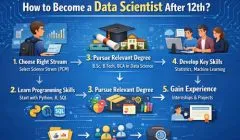
Phase 1 (0–2 Months)
- Python + Statistics
- SQL basics
Phase 2 (2–4 Months)
- Data analysis
- Machine learning
Phase 3 (4–6 Months)
- Projects
- Model deployment
Phase 4 (6–8 Months)
- Generative AI
- Interview preparation
This is a realistic data science learning roadmap.
FAQ Section
1. Is an online data science course enough for freshers?
It is enough only if combined with practical projects, strong fundamentals, and interview preparation.
2. Can I get a job after 6 months of data science training?
Yes, if you follow a structured roadmap and build real-world projects.
3. Do companies hire without experience?
Yes, but they expect strong project experience instead of job experience.
4. Is generative AI required for data science jobs?
In 2025, it is becoming a key differentiator.
5. What is the best way to learn data science in India?
Through structured data science training with placement assistance and mentorship.
6. How many projects are required?
2–3 strong, end-to-end projects are enough if they are production-level.
7. Can working professionals switch to data science?
Yes, with proper planning and consistent learning.