The Reality No One Tells You
India is sitting on more than 1.8 million data-related job opportunities in 2026, yet a majority of learners never reach interview level. The issue is not intelligence. It is not background. It is learning direction.
Most learners:
- Watch 50+ tutorials
- Learn 10+ tools
- Still cannot solve one real problem
That is where everything breaks.
The easiest way to learn data science is simple but uncomfortable:
Stop learning randomly. Start building systematically.
Why Data Science Feels Hard
Before jumping into learning, you need to understand why most people fail.
Problem 1: Too Much Content, No Structure
YouTube, courses, blogs — everything teaches something different. Beginners don’t know what to ignore.
Problem 2: Theory Overload
Many courses start with heavy math or complex algorithms. That kills motivation early.
Problem 3: No Real Application
Learners understand concepts but cannot apply them to business problems.
The Truth
Data science becomes easy when:
- You learn only what is required
- You apply immediately
- You build real outputs
The Simplest Way to Think About Data Science
Forget complicated definitions.
Data science is just this:
Take raw data → clean it → analyze it → solve a business problem → explain results
That’s it.
Everything you learn should connect to this pipeline.
The 2026 Learning Formula
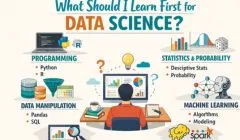
Step 1: Learn Just Enough Python (Not Everything)
Focus only on:
- Variables and data types
- Loops and conditions
- Functions
- Basic libraries
You are not becoming a software developer.
You are learning a tool to work with data.
Step 2: Master SQL Early (Big Mistake If You Skip This)
In 2026, SQL is not optional.
Most company data lives in databases, not Excel files.
You must know:
- SELECT, WHERE
- JOINS (very important)
- GROUP BY
- Window functions
If you know SQL well, your chances of getting shortlisted increase significantly.
Step 3: Learn Data Handling (This Is Where Jobs Are Won)
This is the most underrated skill.
You should be able to:
- Clean messy data
- Handle missing values
- Transform raw datasets
- Create meaningful features
Tools:
- Pandas
- Excel (still widely used in companies)
Reality check:
80% of your job will be data cleaning, not machine learning.
Step 4: Visualization = Communication Power
If you cannot explain your data, your work has no impact.
Learn:
- Bar charts
- Line graphs
- Heatmaps
- Dashboards
Tools:
- Power BI (very high demand in India)
- Tableau
Good visualization = strong interview performance.
Step 5: Learn Machine Learning (But Smartly)
Do not go deep into math.
Focus on:
- Regression
- Classification
- Model evaluation
Understand:
- When to use which model
- How to improve results
- How to explain predictions
That is enough to get hired.
What Recruiters Actually Want in 2026
Let’s be very clear.
Recruiters are NOT looking for:
- 20 certificates
- Complex algorithms
- Fancy jargon
They are looking for:
- Real projects
- Clear thinking
- Problem-solving ability
3 Projects That Can Get You Shortlisted
1. End-to-End Sales Dashboard
What you do:
- Clean raw sales data
- Analyze trends
- Build dashboard in Power BI
What recruiter sees:
You understand complete workflow.
2. Customer Churn Prediction
What you do:
- Identify why customers leave
- Build prediction model
- Suggest business improvements
What recruiter sees:
You can connect data with business decisions.
3. Salary Prediction (India Dataset)
What you do:
- Analyze job data
- Predict salary trends
- Visualize insights
What recruiter sees:
You understand real-world data patterns.
Tools You Actually Need
Core Stack (Enough to Get a Job)
- Python
- SQL
- Pandas
- Power BI / Tableau
- Scikit-learn
Optional Add-ons
- GitHub (for portfolio)
- Excel
- Basic cloud knowledge
What You Should Ignore Initially
- Deep learning
- Big data tools
- Advanced mathematics
Keep it simple. Go deep where it matters.
Salary Reality in India
| Role | Skills | Salary |
|---|---|---|
| Data Analyst | SQL, Excel, BI | 5–9 LPA |
| Data Scientist | Python, ML | 7–16 LPA |
| ML Engineer | Advanced ML | 12–28 LPA |
.
Where Most People Go Wrong
If you avoid these mistakes, you are already ahead of 70% learners.
- Learning without building
- Jumping between courses
- Ignoring SQL
- Fear of coding
- Waiting to “feel ready”
You don’t become ready.
You become ready by doing.
The Smartest Way to Learn
If you want to reduce time and confusion:
- Learn from structured programs
- Work on real-time projects
- Get mentorship
- Follow a proven roadmap
This removes trial-and-error and speeds up results.
Final Thought
Data science is not difficult.
It only feels difficult when:
- You learn randomly
- You avoid practice
- You chase perfection
If you:
- Follow structure
- Build projects
- Stay consistent
You can become job-ready in months.
Frequently Asked Questions
1. What is the easiest way to learn data science in 2026?
Follow a structured roadmap focusing on Python, SQL, data handling, and real-world projects instead of random tutorials.
2. Is SQL really important for data science?
Yes. In 2026, SQL is mandatory because most company data is stored in databases.
3. Can a beginner become a data scientist?
Yes. Many professionals switch from non-technical backgrounds using structured learning and projects.
4. How long does it take to get a job?
With consistent effort, 4–6 months is enough to become job-ready.
5. Do I need strong math skills?
No. Basic statistics is enough for most entry-level roles.
6. Which tool should I learn first?
Start with Python and SQL, then move to data analysis and visualization tools.
7. Are projects more important than certificates?
Yes. Recruiters prefer candidates who can demonstrate real work through projects.