Introduction
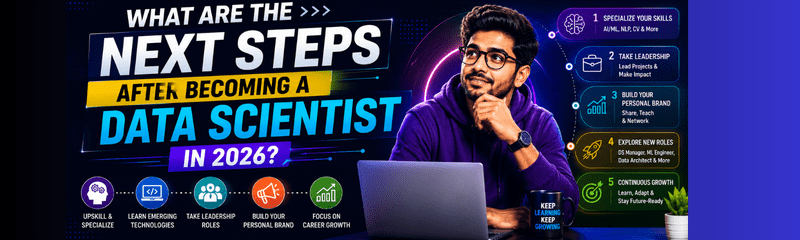
If you are asking what are the next steps after becoming a data scientist, it means you already understand an important industry reality:
Data Science is not the final destination anymore.
In 2026, companies expect data scientists to move beyond dashboards and prediction models into AI engineering, Generative AI, MLOps, cloud deployment, automation, and business strategy.
The professionals growing fastest today are the ones who continuously upgrade their skills after entering data science roles.
And honestly, technology changes faster than people update their LinkedIn headlines.
.
Why Career Growth After Data Science Matters
The data science industry is evolving rapidly because businesses now require:
- AI-powered automation
- Real-time analytics
- LLM-based applications
- Scalable ML systems
- Cloud-native AI infrastructure
- Production-ready deployment pipelines
A data scientist who only builds notebooks may struggle in future enterprise environments.
The next career step should focus on specialization and scalability.
Top Career Paths After Becoming a Data Scientist
1. Generative AI Engineer
Why Generative AI Is the Biggest Next Step After Data Science
Generative AI is transforming software development, automation, enterprise workflows, and AI applications.
Modern AI systems now use:
- LLMs
- RAG architecture
- AI agents
- Vector databases
- Prompt engineering
- Fine-tuning models
Skills to Learn:
- LangChain
- OpenAI APIs
- Claude AI
- RAG Pipelines
- Vector Databases
- Prompt Engineering
Career Roles:
- Generative AI Engineer
- LLM Engineer
- AI Application Developer
Salary Range in India:
₹12 – ₹40+ LPA
What Readers Should Observe:
- Generative AI demand is growing faster than traditional ML
- Companies want AI implementation specialists
2. MLOps Engineer
Why MLOps Is Important After Becoming a Data Scientist
Most companies struggle with deploying ML models into production.
MLOps solves this problem.
Skills:
- Docker
- Kubernetes
- MLflow
- Kubeflow
- Jenkins
- CI/CD for ML
Benefits:
- Better production deployment skills
- Enterprise AI opportunities
- Higher salary growth
What Readers Should Observe:
- Deployment skills are becoming mandatory
- MLOps bridges AI and DevOps
3. AI Solutions Architect
This role focuses on designing enterprise AI systems.
Responsibilities:
- AI workflow design
- Cloud architecture
- AI integration planning
- Business AI strategy
Best For:
Experienced professionals with technical + business understanding.
4. Deep Learning Specialist
If you enjoy research-heavy AI work, Deep Learning is a natural progression.
Technologies:
- TensorFlow
- PyTorch
- Transformers
- CNN
- NLP
- Computer Vision
Applications:
- Healthcare AI
- Autonomous systems
- NLP products
- Vision systems
5. Data Engineering
Data Engineers build scalable infrastructure for analytics and AI.
Without data engineering, enterprise AI systems fail.
Tools:
- Spark
- Hadoop
- Kafka
- Airflow
- Snowflake
What Readers Should Observe:
- Data pipelines are critical for AI systems
- Big companies heavily invest in data engineering
6. Cloud AI Engineer
Modern AI runs on cloud platforms.
Important Cloud Services:
- AWS SageMaker
- Azure AI Services
- Google Vertex AI
Benefits:
- Better deployment capabilities
- Enterprise-level opportunities
- Hybrid AI-cloud expertise
Best Career Paths After Becoming a Data Scientist
| Career Path | Demand Level | Salary Potential | Best For |
|---|---|---|---|
| Generative AI Engineer | Very High | ₹12–40 LPA | Future AI Careers |
| MLOps Engineer | Very High | ₹10–30 LPA | AI Deployment |
| AI Architect | High | ₹20–50 LPA | Senior Professionals |
| Deep Learning Specialist | High | ₹12–35 LPA | Research AI |
| Data Engineer | High | ₹8–25 LPA | Infrastructure |
| Cloud AI Engineer | High | ₹10–28 LPA | Enterprise AI |
Most In-Demand Skills After Data Science
| Skill Area | Percentage |
|---|---|
| Generative AI | 30% |
| MLOps | 20% |
| Cloud AI | 20% |
| Deep Learning | 15% |
| Data Engineering | 10% |
| AI Leadership | 5% |
What Readers Should Observe from This Chart
- Generative AI dominates future hiring trends
- Cloud + AI integration is rapidly increasing
- Production deployment skills are becoming essential
Should You Specialize or Become Full Stack AI Professional?
There are two paths:
Specialist Path
Focus deeply on:
- NLP
- Deep Learning
- Computer Vision
- Generative AI
Full Stack AI Path
Learn:
- Data Science
- Cloud
- Deployment
- MLOps
- AI Integration
Industry Trend:
Companies increasingly prefer end-to-end AI professionals.
How to Grow Faster After Becoming a Data Scientist
Step 1:
Build production-ready projects
Step 2:
Learn cloud deployment
Step 3:
Master AI frameworks
Step 4:
Understand business applications
Step 5:
Improve communication & leadership
Because eventually, explaining AI becomes as important as building it.
Future Trends After Data Science
Emerging Areas:
- AI Agents
- Autonomous Workflows
- AI Automation Systems
- Enterprise LLM Applications
- RAG Architectures
- Multi-Agent Systems
Key Observation:
The future is shifting from “model training” toward “AI system engineering.”
Importance of Practical Training
Many professionals struggle because they know theory but lack implementation experience.
Practical learning should include:
- Live AI projects
- Cloud deployment
- Real-time scenarios
- Enterprise workflows
- Production architecture
NareshIT provides training in:
- Data Science
- Generative AI
- RAG
- Claude AI
- DevOps
- AWS
- Azure
- Cloud Computing
with real-time trainers, mentorship support, and placement-focused learning.
Conclusion
If you are asking what are the next steps after becoming a data scientist, the strongest growth paths in 2026 are:
- Generative AI
- MLOps
- Cloud AI
- Deep Learning
- AI Architecture
- Data Engineering
The industry is moving toward scalable AI systems, automation, and enterprise AI integration.
Professionals who continuously upgrade their skills will have significantly better career growth and salary opportunities.
FAQs
1. What is the best career path after data science?
Generative AI and MLOps are among the strongest career paths in 2026.
2. Is cloud computing useful after data science?
Yes, cloud skills are highly valuable for AI deployment.
3. Should data scientists learn Generative AI?
Absolutely. Generative AI demand is growing rapidly.
4. Is MLOps difficult to learn?
It requires DevOps and deployment understanding but offers strong career growth.
5. What skills are needed after becoming a data scientist?
AI deployment, cloud, MLOps, and advanced AI engineering skills are highly important.