Introduction
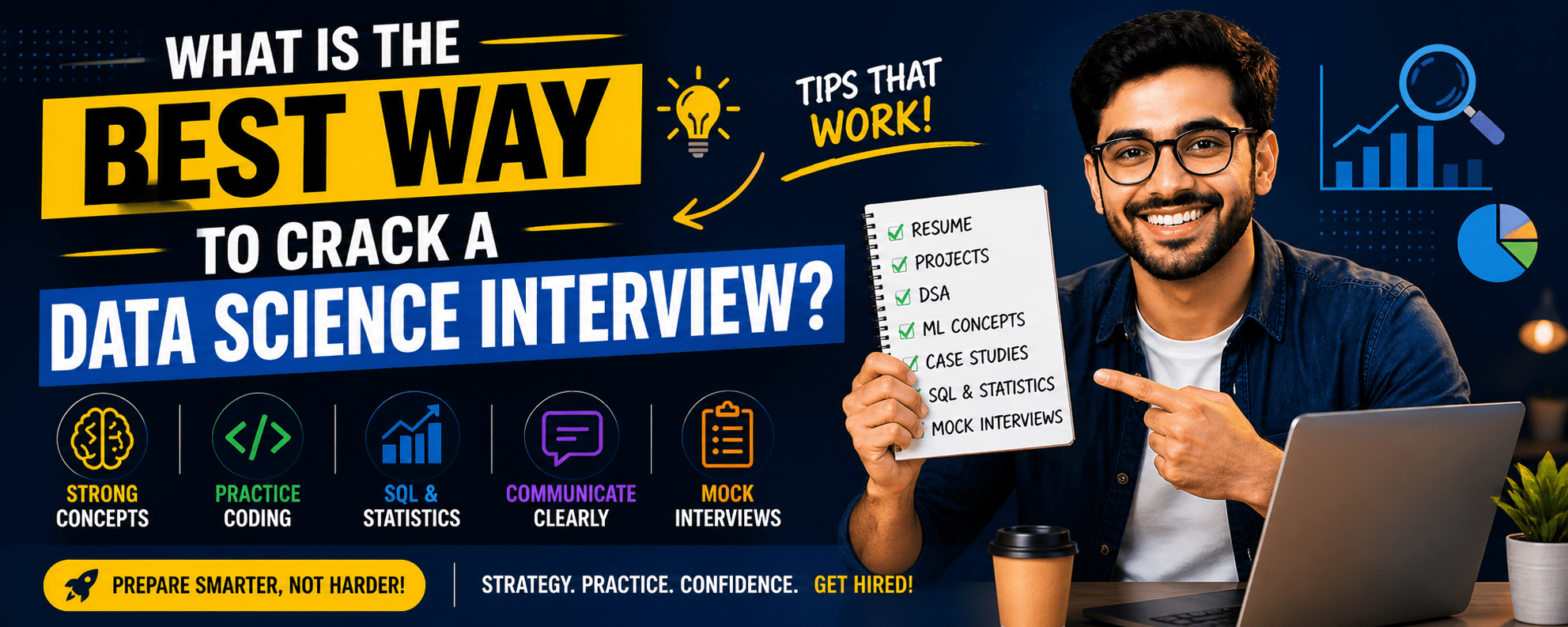
The best way to crack a data science interview is to prepare across the exact areas companies test: coding, SQL, statistics, machine learning, projects, and communication.
Many candidates waste months watching random videos, collecting certificates, and avoiding mock interviews like they owe them money.
Smart candidates prepare with intention.
If you want offers in 2026, focus on what interviewers actually ask—not what social media gurus dramatically whisper.
What Companies Test in a Data Science Interview
Most interviews evaluate these 6 pillars:
- Python Programming
- SQL & Data Querying
- Statistics & Probability
- Machine Learning Concepts
- Projects & Business Thinking
- Communication & Confidence
Miss one pillar and the ceiling falls on you.
1. Master Python to Crack a Data Science Interview
Python is core for most roles.
Focus Areas:
- Lists, dictionaries, sets
- Functions and OOP basics
- NumPy
- Pandas
- Data cleaning
- File handling
- Loops and comprehensions
Practice Questions:
- Remove duplicates from list
- Handle missing values in DataFrame
- Merge two datasets
- Optimize slow code
Know how to solve problems, not just import libraries theatrically.
2. Learn SQL Properly
Many jobs use SQL daily.
Must-Know Topics:
- SELECT, WHERE, GROUP BY
- JOINS
- Subqueries
- Window functions
- CTEs
- Aggregations
Common Questions:
- Second highest salary
- Monthly retention
- Top customers by revenue
- Duplicate record detection
If SQL scares you, that’s between you and your life choices.
3. Build Statistics Confidence
Data science without statistics is cosplay.
Core Topics:
- Mean, median, variance
- Probability
- Hypothesis testing
- p-value
- Confidence intervals
- A/B testing
- Central Limit Theorem
Interview Angle:
They care less about formulas, more about when to use them.
4. Understand Machine Learning Deeply
Don’t memorize model names like Pokémon.
Learn:
- Regression vs Classification
- Overfitting / Underfitting
- Bias-Variance Tradeoff
- Cross-validation
- Feature engineering
- Model evaluation metrics
Be Ready to Explain:
- Why Random Forest?
- Why Logistic Regression?
- Why precision over recall?
That “because tutorial used it” answer is not elite.
5. Projects Win Interviews
Your project section often decides your fate.
You Must Explain:
- Business problem
- Dataset source
- Cleaning process
- Why chosen model
- Results
- Improvements possible
Strong Project Ideas:
- Customer churn prediction
- Sales forecasting
- Fraud detection
- Recommendation system
- NLP sentiment analysis
If you copied the project, the interview will become performance art.
6. Prepare Business Case Studies
Real companies want thinkers.
Example Questions:
- How would you reduce churn?
- How would you detect fraud?
- How would you increase app engagement?
- How would you measure campaign success?
Use This Structure:
- Clarify goal
- Define metrics
- Suggest data sources
- Propose solution
- Mention risks
Simple framework. Much better than panic.
7. Improve Communication Skills
Some candidates know a lot and explain nothing.
Practice:
- Speak clearly
- Structure answers
- Use examples
- Avoid rambling
- Admit what you don’t know honestly
Confidence without competence is loud nonsense. Competence without communication gets overlooked.
30-Day Best Way to Crack a Data Science Interview Plan
Week 1:
Python + SQL basics
Week 2:
Statistics + ML theory
Week 3:
Projects revision + case studies
Week 4:
Mock interviews + resume polishing
Repeat weak areas. Humans hate this part.
Common Mistakes Candidates Make
- Ignoring SQL
- Memorizing definitions only
- Cannot explain projects
- No mock interviews
- Weak resume
- No business understanding
- Talking too much / too little
A delicate art.
How Freshers Can Crack a Data Science Interview
If you are a fresher:
Focus on:
- 3 strong projects
- Python basics
- SQL practice
- ML fundamentals
- Clear communication
Freshers are not expected to know everything. Just enough to be useful and trainable.
How Working Professionals Can Crack It
If switching careers:
Emphasize:
- Domain expertise
- Transferable skills
- Analytical thinking
- New technical projects
Your previous experience can become an advantage if presented intelligently.
Conclusion
The best way to crack a data science interview is to prepare in the same structure companies evaluate:
- Python
- SQL
- Statistics
- Machine Learning
- Projects
- Communication
If you want guided preparation, mock interviews, real-time projects, and placement-focused training, many learners choose Naresh IT for data science interview readiness.
Which is often more effective than self-studying in 19 browser tabs while spiraling.
FAQs
1. How long does it take to crack a data science interview?
Usually 1–3 months of focused preparation.
2. Is SQL mandatory?
Yes, for most data roles.
3. Are projects important?
Extremely important, especially for freshers.
4. Do freshers get selected?
Yes, with proper skills and projects.
5. Is coding round difficult?
Usually moderate if you practice consistently.